

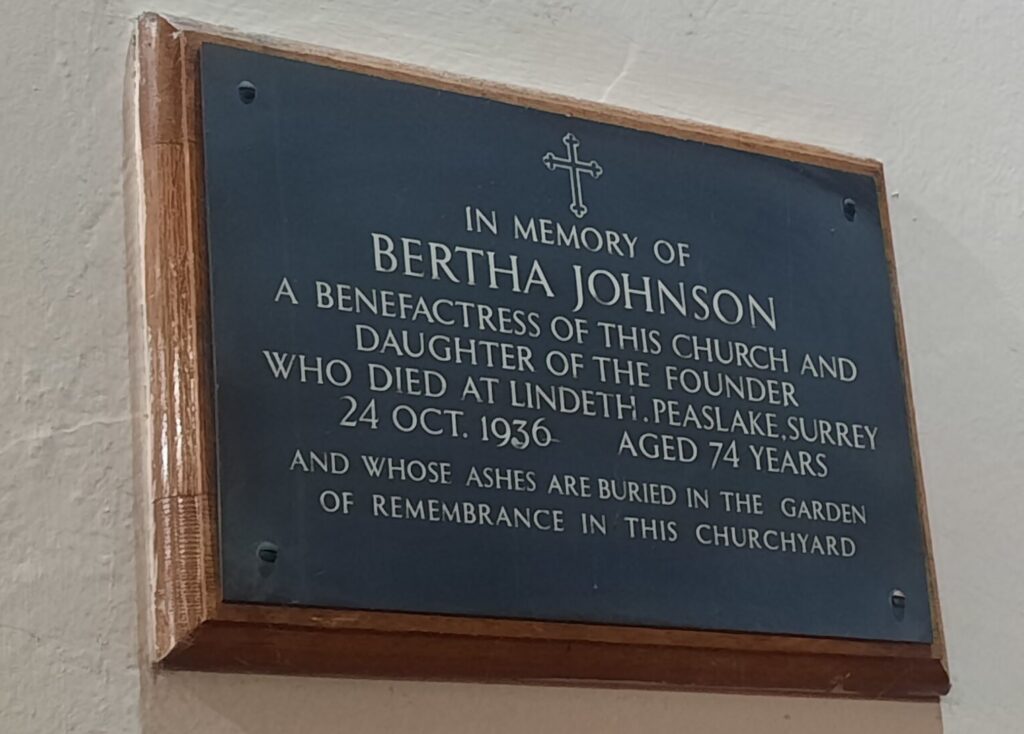
When we visited St. James and St. Elizabeth’s church in Bickershaw we learnt about the family of James and Elizabeth Johnson. Their children paid for the church in the growing pit village in memory of their parents. One of those children was Bertha and she is commemorated with a memorial plaque in the church. A conversation over coffee with parishioners alerted us to Bertha’s interesting life.
Bertha was the sixth child and fourth daughter of the 13 children of James and Elizabeth. James was a director of Abram Coal and Cannel Company which owned most of the local pits.
Bertha was born in 1862 in Hindley and the family lived in Low Green Hall, in Low Green Road. She was baptised at All Saints church in Hindley. Bertha and her siblings were educated at home by a governess, Caroline Eliza Taylor. Bertha showed early artistic talent, and in the census of 1891, was listed as an artist. By then the family had moved to Southport, like many other wealthy Wigan families.
At some point, Bertha became a committed supporter of women’s rights and it is possible that she met the leading suffragette, Emmeline Pankhurst, when both families were living in Southport. By 1893, after both her parents had died, Bertha had left Southport and moved to London. Support for votes for women was strong in Lancashire but there was even more happening in London and perhaps that was one of the reasons behind her move.
We know that in 1901 Bertha and her sister Mabel were living in a mansion block in Kensington with a couple of female servants. In the census of that year, the column for Bertha’s occupation was left blank. The women had the inheritance from their parents’ estate (James left over £303,000 in his will) so there was no need for them to work. These were years of great suffragette activity with women being arrested and force fed in prison. Whilst we have no evidence that Bertha took part in direct action (she was a suffragist), her time in London must have been exciting.
Nine years later Bertha had left London and moved to rural Surrey, to Torrells Cottage in the village of Peaslake, The seemingly sleepy village had the reputation of being a hot bed of the women’s suffrage movement.
Edwin Waterhouse, (coincidentally, brother of the architect Alfred Waterhouse who designed Wigan Museum and Ince cemetery chapels) who lived locally, wrote in his memoirs in 1912 that
‘The village……was ‘rather a nest of suffragettes’ and that ‘there are fourteen ladies there of very advanced views’.
Bertha does not appear at all in the 1911 census. Many suffrage followers boycotted this census and refused to fill in any details or wrote remarks under protest, ‘No vote, no census, as women do not count, they refuse to be counted.’ This might explain Bertha’s absence from the record.
At the age of 50, Bertha purchased a plot of land in Peaslake and built Lindeth House, where she lived until she died. She took a great interest in village life and in 1922 helped to negotiate the provision of a dedicated room for the Women’s Institute in the new village hall, making a substantial donation.
About the same time, in a radical turn of events, Bertha, single and in her 50s, adopted a little girl. There appear to have been no formal adoption papers. For a single woman in the early 1920s to adopt a child must have been a brave and unconventional decision. But this was very much in line with her strong suffragette principles, Emmeline Pankhurst herself having adopted four children. The child, Phoebe Bertha Johnson, was listed in the 1921 census as an adopted child, age four, with her birth place as London, ‘Parish not known’. Living with Bertha and Phoebe were three female servants – a children’s nurse, a cook and a parlourmaid.
It would be interesting to know what Bertha’s siblings thought about the adoption. Was Bertha seen as doing something admirable to adopt a child who couldn’t be looked after by their birth parents? Or was she seen as a rebel, maybe something of a threat.
Bertha’s links to Bickershaw remained strong. In 1905 she attended the Consecration Service of St. James and St. Elizabeth’s church with her siblings. Did she return, possibly with Phoebe, some years later when the stained glass window in memory of her three nephews who were all killed in the First World War was dedicated? We’d like to think so.
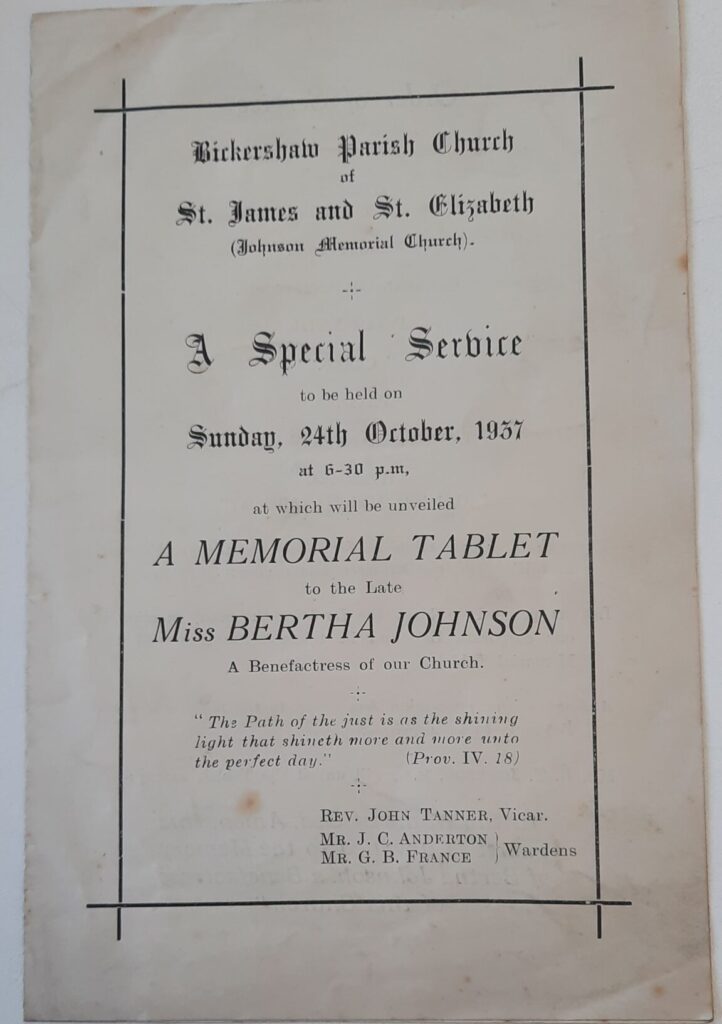
When Bertha died aged 74, her sister, Mary, registered the death in Surrey. Bertha was cremated but her ashes were returned to the area of her birth and buried in the churchyard in Bickershaw reflecting how much the church and her family meant to her. In her will she left £200 to St. James and St. Elizabeth’s church and in 1937 a special service was held when the memorial tablet was unveiled.
In a project dominated by the lives of men, it has been refreshing to celebrate the life of an unconventional woman with strong beliefs and principles.
With thanks to David Pott for his help with this post. David’s wife Caroline is the great niece of Bertha and great granddaughter of James and Elizabeth.
Read about two more women who are commemorated in a church in Wigan
© Who Built Wigan's Churches 2024 - .
All rights reserved.