

St. James and St. Elizabeth church is situated in a pretty garden just off the main road in the former pit village of Bickershaw. It is a lovely little church with an interesting history. Like St. Matthew’s, Highfield it was built as a Memorial Church. The children of James Henry and Elizabeth Orme Scarlett Johnson donated the money for it in memory of their parents and in the early days it was referred to as the ‘Johnson Memorial Chapel’. The Johnson family owned the Abram Coal Company who ran many of the local collieries.
We can only imagine the excitement when the Bishop of Liverpool, The Right Revd. Francis Chavasse, laid the Foundation Stone on 9 July 1904. This can be seen outside near the vestry. Clergy and choir processed from the nearby school in fine weather to the church’s site and the Bishop with accustomed ceremonies laid and afterwards proved the stone and declared it well and truly laid. In his sermon he thanked the Johnson family for their generosity and said, ‘If he himself were a rich man and desired to put up a memorial to those he had loved and lost, he could think of nothing better than a house of the Living God’.
But he went on to say that the church was being built for the people of Bickershaw. It would not be the church of those who built it, but the church of the place. It must never be spoken of as Mr. Johnson’s church but as ‘our’ church.
‘Our’ church is a small church to serve a small community. Built out of fine red Rainhill stone, it is a simple building, just a nave and a chancel with vestries to the north. Inside the walls are plastered and painted white. The wooden panelled roof, chancel arch and stone tracery of the windows combine to make a complete Edwardian interior.
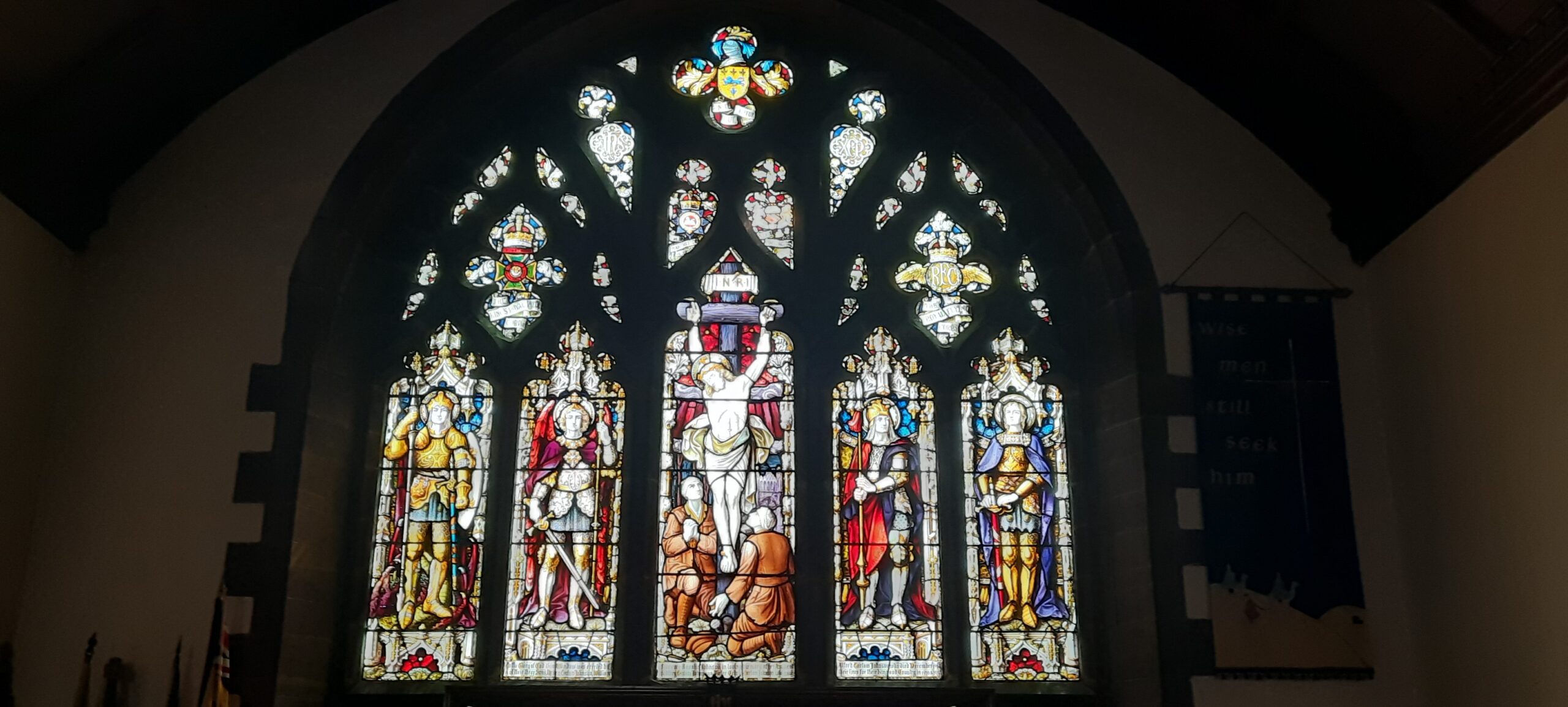
It is the windows that command attention. In particular, the window above the altar which commemorates the three Johnson brothers who died in the First World War. Two soldiers in uniform kneel at the foot of the Crucifixion Cross with saints on either side. For the people of Bickershaw, they must have represented all the men listed on the war memorial in the church garden.
All the stained glass was made by Allan Barrowclough of Lancaster and Preston. This is a maker we have not seen before in Wigan, so we were very pleased to find it. Is there any more glass made by the same firm elsewhere in Wigan?
The Centenary Booklet has some great memories which we will publish in our projects section, Bill Whelan’s memories of Walking Day being our favourite.
Revd. Kelvin Power was vicar during the Miners’ Strike of 1984 to 1985. You wonder what challenges he had to face.
Beautifully carved altar
Hammerbeam roof

© Who Built Wigan's Churches 2024 - .
All rights reserved.