
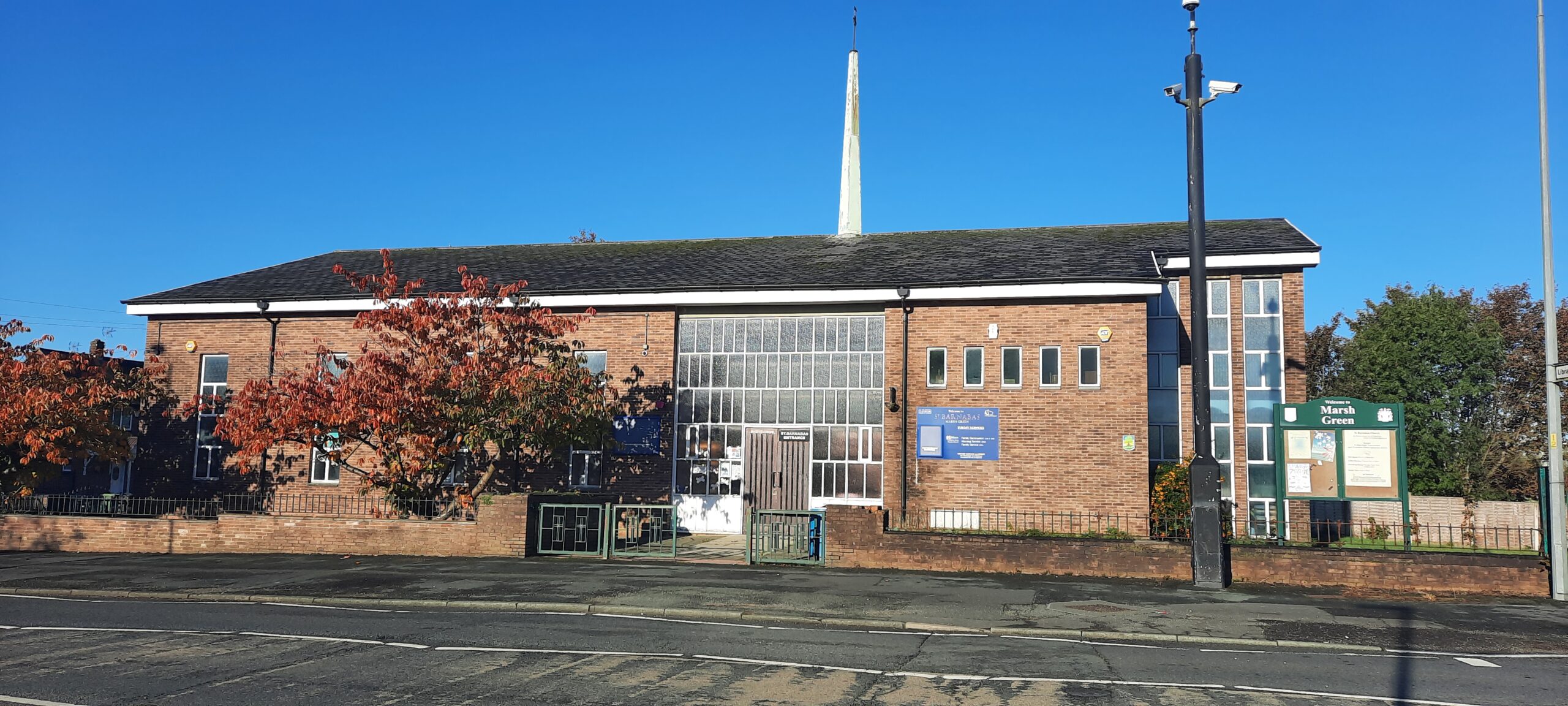
The church we see today was built in the early 1960s to serve the new housing estates in the Marsh Green area. Built without finance from a local donor, the building is modest and functional with a tall thin spire to indicate that it is a church. It was designed to serve the needs of the local growing population and fits well into the neighbourhood opposite the library and shopping centre. It is very different in concept and style from the area’s older and grander churches, St. Matthew’s in Highfield and St. Elizabeth’s in Aspull for example.
We have enjoyed the challenge of researching the history of St. Barnabas and have found information in unexpected places. We have searched the Wigan Observer to find the report of the present church’s consecration in 1961. You have to smile at its tone. The Bishop of Warrington, the Rt. Revd. Laurence Brown, said that the new church had been sited in the heart of the shopping centre in Marsh Green. He hoped that when the ladies were doing their shopping they would cross the road to say a short prayer. 1960’s optimism no doubt but the origins of St. Barnabas go back much further.
We first found out about a building where church services could be held in Marsh Green when we were researching St. Andrew’s in Springfield situated just to the east across the River Douglas and the canal. Around the year 1870 Revd. Arthur Legge, a curate at All Saints, the Parish Church, was asked by the Rector of Wigan, Revd. Bridgeman, to start a church in the Marsh Green and Springfield areas. There were schools in Marsh Green and Beech Hill and Revd. Legge began to hold services in both of them. Perhaps Beech Hill School was used more as Revd. Legge writes, ‘I hope too that the heightening of Martland Bridge is only the first step towards raising the road on the Pemberton side, so that the Marsh Green people might attend our services without having to wade up to their ankles or knees in wet weather.’
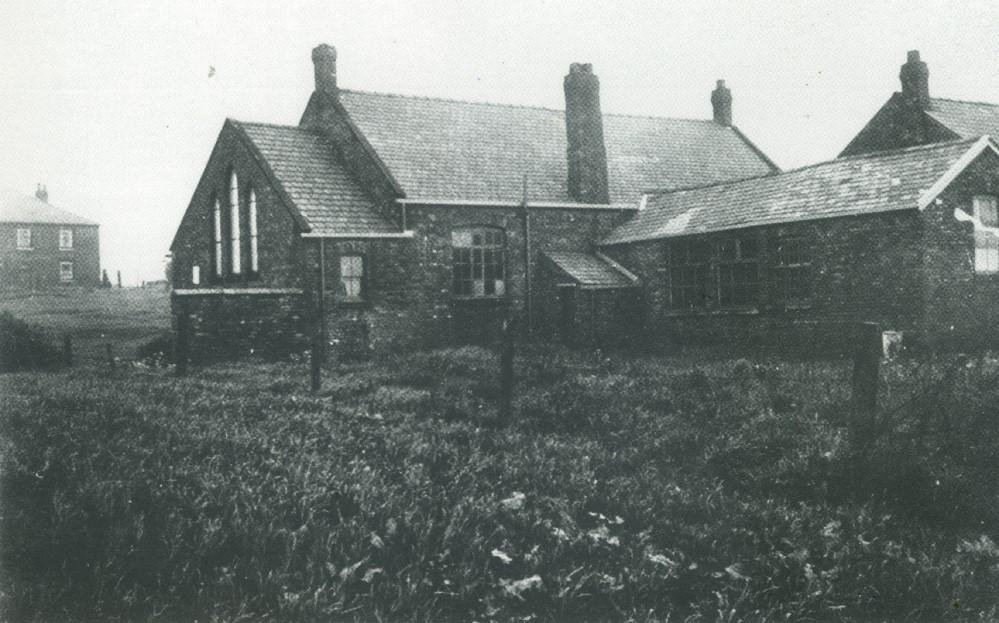
On the 1884 Ordnance Survey (OS) map there is indeed a school in Marsh Green situated on the corner of Scot Lane and Marsh Green and by 1909 it is labeled as St. Barnabas School. It’s reasonable to assume, we think, that it was also used as a Mission Church with church services held on a Sunday. The Wigan Observer report about the present church’s consecration in 1961 looks back fondly at the old church confidently telling us, ‘The old building had a history of 150 years. It was erected in other very exciting days as an invasion by the French under Napoleon, was threatened.’ A remarkable claim to claim to make. It would be interesting to see the source of their information!
St. Mark’s Church close to ‘The Saddle’ in Newtown opened in 1891 and it seems likely that that is when the oversight of the Mission Church passed from St. Andrew’s to the new parish in Newtown. There’s a fleeting glimpse of the Mission in the early twentieth century from a Wigan Observer search. We learn that in 1900 the Mission raised 6s and 6d for Hospital Sunday. The 1904 Sunday School Field Treat, however, gets a write up. Here it is in full:
‘The scholars numbering over 300, were given their field treat on Saturday last, and excellent arrangements had been made for the event, which had been looked forward to with glee by the children. The procession, which was a credit to all concerned, was accompanied by Revd. J. Thompson (curate), the several officials, and the Pemberton Total Abstinence Band, and after marching through the village and along Scot Lane, turned into Marshall Field, which was generously placed at their disposal for the afternoon by the Urban District Council.
Refreshments of an enjoyable nature were here given out by a large staff of workers, and, after a brief rest, sports and games of a miscellaneous character were indulged in, and dancing to the strains of the band also found many patrons. The proceedings were most successful as they were favoured with delightful weather.’
Peace and harmony appear to be the order of the day, but it wasn’t always so. The Wigan Observer of January 1910 has a notice which states starkly that the Sidesmen and Members of the Choir of St. Barnabas, Marsh Green wish to disassociate themselves completely from the ‘slanderous and base accusations’ made against the church’s late organist and choirmaster, Thomas Dawber. We’ll probably never know what had happened but it was clearly serious enough for this very public statement to be published.
Moving on to 1930s the OS map shows the building labelled as a Sunday School so perhaps by then the Day School had found other premises and the building was serving simply as a Mission Church and Sunday School.
An undated photograph on WiganWorld shows a very simple L shaped building with one part higher and ending in pointed windows this probably being where the altar stood perhaps behind shutters as in other Wigan Missions. The parish magazine of St. Marks’s Newtown in 1942 lists weekly activities in St. Barnabas as follows:
Sunday School, 2.15 p.m.
Bible Class, 3 p.m.
Women’s Fellowship, Monday, 7 p.m.
Young Folks’ Club, Friday, 7 p.m.
Holy Communion as announced.
So, by then it would appear that the Mission was Consecrated as a fitting place where Holy Communion could be celebrated.
But it is another surviving document, still preserved in the church, which gives a real insight into the life of the Mission. St. Barnabas, Marsh Green: Minute Book of Annual General Meetings is a well-used, old fashioned, hardbacked notebook with handwritten detailed accounts of meetings recorded in great detail.
We learn that in 1929 the need for a new banner was clearly a matter of great importance. Four resolutions were needed to agree that the new single banner would depict The Good Shepherd, with measurements of 7 feet by 5 feet, orange and blue as the main colours.
Family tea parties must have been a highlight. Tickets for the 1937 event cost 1s and 3d with tea, prepared naturally by the Women’s Fellowship, to be on the tables at 6.30 p.m. We are told that ‘Sister’ was in charge. We assume ‘Sister’ was one of the ‘Church Army’ sisters who played such an important part in the work of the Mission. Tea began naturally with a welcome from the vicar. ‘We got through the tea very well; there was no waiting at all.’ Then everyone went through to ‘the large room’, presumably the room used as the church and a performance was given by a concert party from All Saints, ‘And it was very good of them to come.‘ The evening ended with the vicar thanking all concerned and with a closing prayer.
By 1934 more serious matters were under discussion. A report written by Messrs. Massey, building contractors, noted the ‘deplorable condition’ of the Mission building especially the amount of dry rot in the woodwork. Effective treatment was estimated to cost £60 and the challenge of raising the money was enthusiastically accepted by the meeting.
The role of the Church Army Sisters at the Mission was clearly important. In 1938 referring to one Sister, who frustratingly isn’t named, the vicar said that, ‘He fully realised what a task it was for Sister to have to take charge at the Mission, but he could not get up to the Mission owing to the amount of work he had to do at St. Mark’s.’ This was over 50 years before the Church of England recognised women priests but St. Barnabas was ahead of the times with women clearly taking a leading role. In 1939 we finally have a name for a Sister when we’re told Sister Anderson arrived taking her first service at the Mission on Sunday 12th March.
Walking Day and Sunday School Treats are, of course, discussed. The route is finalised walking up Scot Lane to the brickworks and returning to ‘the top of Marsh Green’ with games on the Mission Field followed by a ‘tea’. It was also suggested that trollies might be provided for the under-sevens as ‘the procession would be rather a long one.‘
After the Second World War the populations of Marsh Green and Kitt Green grew rapidly with housing estates and new factories being built. The old Mission was no longer fit for purpose and a new church on a different site was planned. It was to be a new type of church, very much part of the ‘new town’, easily visible from the road and the shopping centre with additional rooms for church organisations replacing the cramped Mission.
By 1956 plans were well advanced and a Liverpool based architect, Mr. Bruxby, had been appointed. He designed a number of schools and churches in the Liverpool Diocese. By 1959 the Building Fund amounted to £1,856. A sum of £444 had been raised during the previous year with family boxes raising an extra £20. The Minute Book (then still in use) stated that the parish needed to maintain the effort as £6,000 to £10,000 would need to be raised by the parishioners themselves towards the estimated £20,000 total cost of the church. The fate of the old Mission had already been decided with discussion following about sale of the soon to be empty site but, for now, the building was still in use with a new oil-burning stove being bought, the use of the building for a Wednesday morning ‘clinic’ helping to offset some of the cost.
Sufficient funds must have been raised or promised and a grant from Liverpool Diocese was received and on 6th May 1960 the Foundation Stone, still to be seen to the right of the main entrance, was laid by the Archdeacon of Warrington, Ven. Eric Evans. The building was to comprise a church, a hall with a stage, a curate’s flat, two classrooms and a kitchen.
On 6th May the clergy gathered in the old Mission and, with the Mayor of Wigan, choir, lay readers and the churchwardens, processed from there to the site of the new church marshalled, we’re told, by Revd. Eric Beard, Vicar of St. Andrew’s perhaps in acknowledgement of those early days when Revd. Legge curate of St. Andrew’s started taking services in the school in Marsh Green.
The building worked started. Six months later plans were altered to make the parish rooms larger, the expense being borne by the parish.
(It’s always a source of regret to us that we know so little about the builders and their work. We have searched in vain for the names of the building firm and photographs of the work in progress.)
A year later the church was completed and on 2nd June 1961 the new church was Consecrated, as we have said, by the Bishop of Warrington, Rt. Rev Laurence Brown.
The Wigan Observer reported:
‘A new chapter in the religious life of Wigan Corporation’s vast housing estate at Marsh Green began on Saturday evening, when the new church and hall for St. Barnabas Mission was opened and dedicated for worship by the Bishop of Warrington before an overflow assembly of parishioners from the Mission Church, St. Mark’s Church, Newtown and other churches in the Wigan Deanery.‘
Hymns included ‘O Worship the King’ and ‘We love the place, O God’ and the organist, playing the new organ, was Mr. J. Bradshaw. The Bishop, addressing the congregation, said, ‘When I was in London I took part in the dedication of 200 churches damaged by air-raids. And tonight we have a link with those damaged churches because most of the cost of the new church at Marsh Green was to have been for another building which was not restored after being destroyed by enemy action.‘
As mentioned above he saw the church as an important part of the new community, open for all to go in, to say a prayer while going about their business, shopping in the shops.
The Wigan Observer reporter perhaps a touch sentimentally wrote ’Thoughts that night were as much backwards as forwards. Inevitably, some of those present had known the church of St. Barnabas all their lives and the old building held many sacred memories for them. It was built before St. Mark’s Church, Newtown was thought of and was a building like so many churches in Wigan which was served by Wigan Parish Church.’
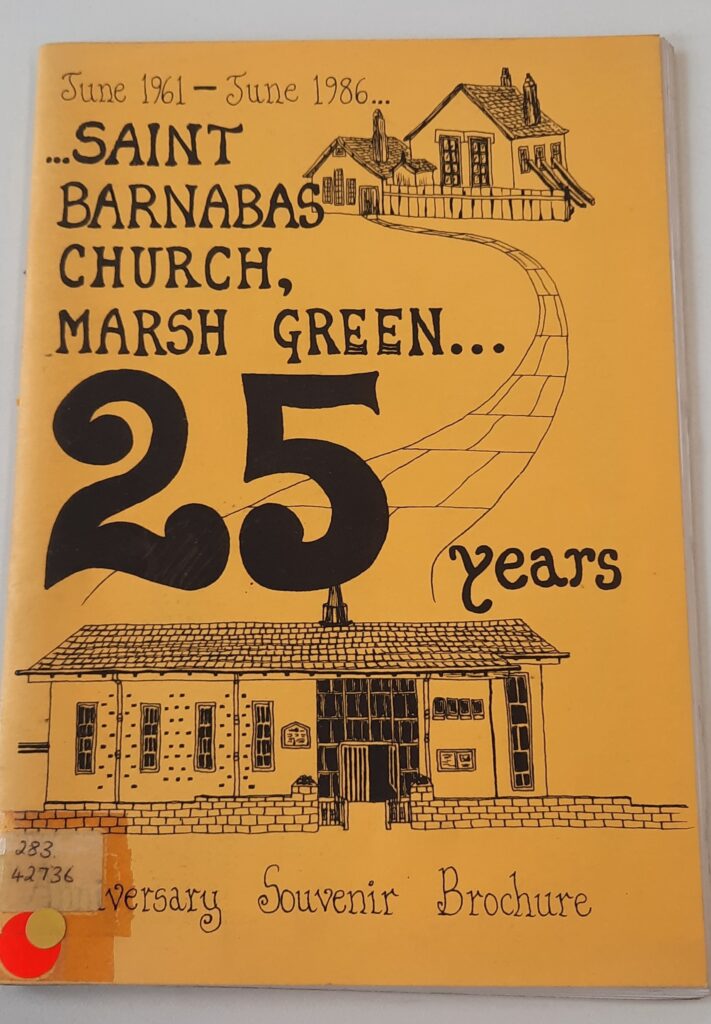
In the 25 years Anniversary Souvenir Brochure, a quote from Mrs. Nelly Heyes gives a picture of church life at St. Barnabas in 1986. She said, ‘There seemed to be a never ending stream of parties, dancing and concerts, of field treats and of Walking Days. The Church Army Sisters ran St. Barnabas Mission well. Amongst them were Sisters Reed, Preston, Atherton, Beswick, Elliot, Fisher, Wilcox, Jackson and Longstaff’.’
One item in the old church is mentioned several times in the Minute Book, the eagle lectern. The new church had smart, modern, wooden fittings including a lectern, but the parishioners must have felt some deep attachment to the old one. ‘The Bird’, as it is referred to in the Minute Book, was offered to another church in Wigan. The offer, however, was declined and the lectern was advertised in the Liverpool Diocesan Leaflet presumably on a ‘new owner to collect’ basis. No takers, so ‘the Bird’ was eventually sold for scrap, raising £9 for the ‘Freedom of Hunger Campaign’.
Soon a fence was erected around the new church and coat pegs were put up in the Wessex School entrance. A Garden of Rest was established and worship and church life settled down as Walking Day photographs clearly show.
The church building is not currently in use but the work of the church most definitely continues with Street Pastors using the library opposite as a base and Communion Services being held there regularly.
© Who Built Wigan's Churches 2024 - .
All rights reserved.