
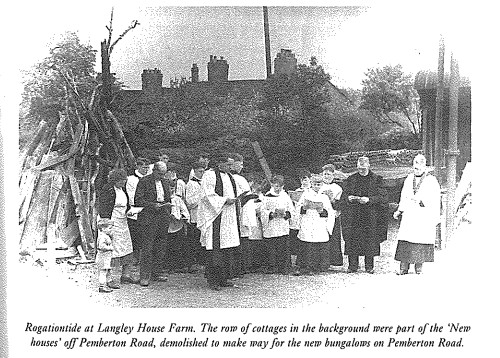
Rogation Sunday is celebrated on the fifth Sunday after Easter. Traditionally it is marked by a procession around the parish when the vicar says prayers over the newly planted crops in the hope that the harvest in the autumn will be a good one. The farm animals are included and hymns and special prayers are said at the different locations, for example, in the fields, by a barn and outside a farmhouse.
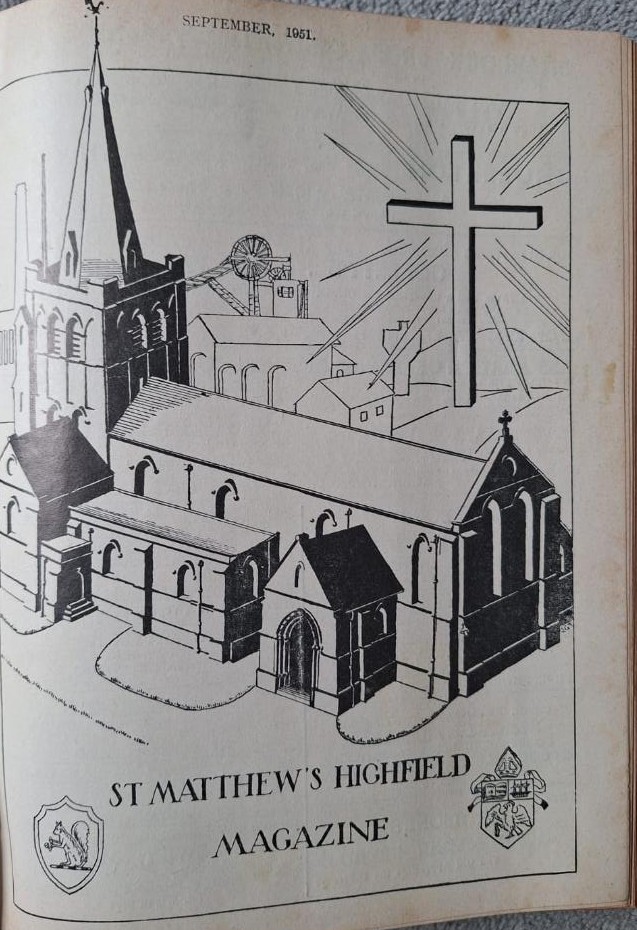
We wonder if Rogation Sunday was (still is?) marked in Wigan’s more rural churches, maybe at Haigh or Aspull. We have, however, found that in the 1950s the Sunday was celebrated at St. Matthew’s in Highfield. It is important to remember that the area south of the church was much more rural in character 70 years ago before the ‘new’ houses were built.
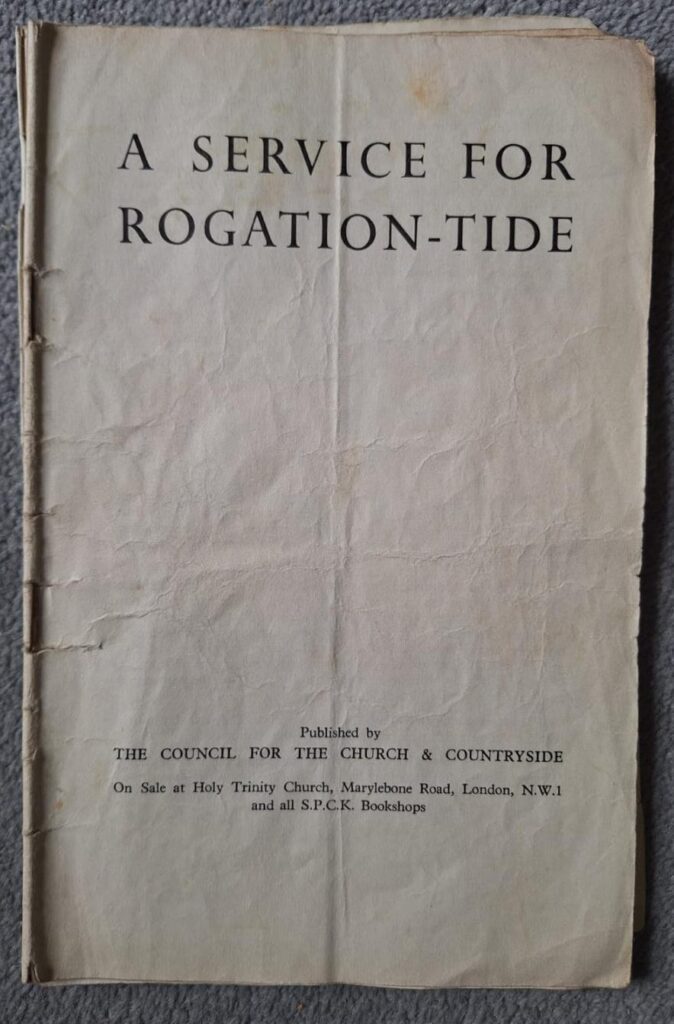
At St. Matthew’s we were shown the well-worn service sheet entitled A Service For Rogation-Tide. It was published by the ‘Council for the Church and Countryside’ and we assume it formed the basis of the service. Mr. Gordon Cooke in his invaluable 1993 book ‘A History of St. Matthew’s, Highfield’ describes what happened and Derek Winstanley, born and bred in Highfield, but now living in the USA, has sent us his memories.
So, using these two accounts, we know that the day began with a short service outside the church led by Ashton born Revd. Walter (Bert) Bullough, vicar from 1944 to 1959. The hymn ‘All People that on Earth do Dwell’ was sung and the vicar explained what the day was all about.
Then the procession, led by the choir, walked up Billinge Road followed by the Sunday School and many parents and other adults who ‘came along to enjoy the pleasant walk through the farms of the parish.’ The first stop was the farmyard at George Acker’s Highfield Farm where Mr. and Mrs. Acker with their son George were there to meet the walkers. The hymn ‘Praise my Soul the King of Heaven’ was sung and Derek remembers Revd. Bullough blessing the two horses, Prince and Duke, the two pigs, six cows, hens and chickens.
The procession walked further down Billinge Road past the Pony Dick pub (demolished 1954) into the grounds of Winstanley Hall to Sam Fouracre’s farm, called Rylance Mill Farm. Again, the vicar blessed the farm animals and prayed for a good harvest. ‘There was a lovely pasture in front of the house, sometimes with horses on it.’
Mr. Cooke tells us that the procession sometimes went up Home Lane towards Winstanley Hall to be met there by the local squire, Captain Bankes and Mrs. Bankes.
Next Derek tells us, ‘We walked across the bottom of Pemberton Road by the bridge over Smithy Brook and along the footpath by the side of Blundell’s Wood to Holmes House Farm where we were met by the Kearsley family. In addition to blessing the farm animals and crops the Vicar blessed the ducks on the pond and we fed them pieces of bread.’ Another hymn was sung. The service sheet said that ‘Lead us Heavenly Father Lead Us’ should be sung next to water perhaps a ‘well, stream or river’, maybe the pond was the closest thing there was!
Mr. Cooke goes on, ‘The vicar ended the service with a blessing. From here the Infants returned to church. It was usually as much as they could manage to walk.’
The rest of the procession went onto Harvey House Hall where the Ashell family lived, before heading back past Tan Pit Cottages where prayers appropriate for gardens and allotments were said. At the next stop, Worthington Fold Farm, Mrs. Halsall had refreshments waiting. There was, Mr. Cooke remembers, orange and lemon drinks for the youngsters, tea and homemade cakes for the adults.
Three more stops for prayers and hymns were made at Tan House Farm, Melling’s Farm and Langley Hall Farm. At each of these the farmers and their families, Miss Wadsworth, the Alker family and Mr. and Mrs. Johnson and their three daughters, greeted the procession,
‘From there the journey was back again along Pemberton Road, down the hill and back to the church where the final prayers and blessings were said outside.’
Before the walk, the vicar and the choir went by car to bless three farms, Windy Arbour, Sandyforth and Jamieson’s, which were too far away to be included in the walk.
Mr. Cooke ends his account thus: ‘The collections taken on the Rogation Walk were always good. The farmers were very generous in their contributions and thank-offerings for the visit to their farms. The weather was usually very kind to us, and the walk was a most enjoyable afternoon outing, but I can remember occasions when we took umbrellas and raincoats – just in case!’
Derek reflects on the differences between Rogation Sunday and the parish’s annual Walking Day held in June thus, ‘Rogation was very different from Walking Day, which was so structured, organised, busy and noisy. On Walking Day, parishioners walked through the built up and industrial part of the parish, behind banners and with a band playing to keep you marching, in your best clothes. Up Enfield Street, down Ormskirk Road and along Little Billinge Road back to Highfield with people watching both sides of the road and relatives handed you a few pennies as you marched by.
By contrast, the Rogation Day walk through the fields was low key, slow paced, with nobody lining the paths, and with no financial rewards! There may have been brass band, but I do not recollect any. I do recollect the occasional neigh, brey, moo and grunt though!’
Derek remembers the vicar, Revd. Burrough as, ‘very forthright, a strong church leader and always in control of the situation…a little formidable for a youngster.’
Of Mr. Cooke who wrote that invaluable history of St. Matthews Derek says, ‘Gordon Cooke was a rather quiet but well organised and very loyal church warden. He loved the Church, Highfield and Winstanley and helped build the Church Hall. He lived on Pemberton Road, opposite the Big Stone leading up to Springpool.’
When we set out to research Wigan’s churches, we had no knowledge whatsoever about Rogationtide and one of the most exciting aspects of the process has been the completely unexpected things we have uncovered.
It was David Witter, a most loyal member of St. Matthew’s church, who first told us about Rogationtide. He has recently passed away. David was the very first person to ‘unlock’ a church in Wigan for us and helped us enormously. We post this account on our website as a mark of our affection for him and to record his enthusiasm for our project and his great support.
May he rest in peace.
Image of Rogation Sunday Walk from A History of St. Matthew’s, Highfield by Gordon A. Cooke, published by St. Matthew’s Fellowship, Highfield, November 1993
© Who Built Wigan's Churches 2024 - .
All rights reserved.