

Our background is in Church of England churches but as soon as we started this project, we realised that we wanted to research Roman Catholic churches in Wigan. You only need to walk up Standishgate past St. John’s and St. Mary’s or to go down Wallgate past the sad sight of St. Joseph’s to understand how important these churches are. Beyond the town centre Roman Catholic churches provide a wide variety of buildings, each one with its own story to tell. There are many people in Wigan with greater knowledge than us and we encourage their comments and, indeed, corrections.
We visit churches at least once before we write about them. We have yet to visit most of the Roman Catholic churches in the Wigan area. They are on our list for 2025. We feel, though, at this point in our project, that it is important to acknowledge and celebrate them and so, with the help of Taking Stock, the fantastic website run by the Catholic Bishops’ Conference, we are making a start.
The first surviving church appears to be St. James’s Orrell. This is described on the Taking Stock website as a small chapel, later extended, hidden away behind the priest’s house and as dating from 1805.
Wigan has been described as ‘England’s vintage town for Regency Roman Catholic churches’ and St. John’s and St. Mary’s, dating from that period (about 1820) and only about 100 yards apart on Standishgate, are of national importance.
The first Roman Catholic church in Ashton opened in 1822 funded by the local Gerard family. St. Mary’s, Billinge (1828) looks, from the outside, like a simple non-conformist chapel. We look forward to writing about these historic churches dating back to not long after the time when the Mass had to be celebrated in private.
1850 was, of course, a very important year in the Roman Catholic history of England with the Restoration of the Catholic Hierarchy when Roman Catholic bishops were re-established in the country.
The first church to be built after that great event was Our Lady of the Immaculate Conception in Haigh. We’re told that about 1,000 people, mostly miners, attended the laying of the church’s Foundation Stone in 1857. The Roman Catholic population was beginning to rise.
That population increase continued in the 1860s and 1870s with considerable Irish immigration and typical Gothic Victorian churches were built in the town centre; in Scholes, where St. Patrick’s replaced an earlier church of 1847, and in Hindley where the church, St. Benedict’s, was designed by the famous Catholic architect J.A. Hansom. St. Joseph’s in the town centre was built in 1878 and its size and fine west front reflect the strength of Roman Catholicism in that part of Wigan in the later nineteenth century.
St. Marie of the Annunciation in Standish is the final church of the century maintaining the area’s strong link to Roman Catholicism dating back centuries. In the first decade of the twentieth century, a traditionally designed Gothic church, Our Lady Immaculate, was built in Downall Green (the work of the famous family of architects, the Pugins) and an older building in Ince was replaced by a red brick church, St. William’s, which held 500 people.
After the First World War the buildings become more original. St. Oswald and St. Edmund Arrowsmith in Ashton is said to have been built using local labour to provide relief in the depression of the 1920s. It opened for worship in 1930. Its design is inspired by medieval churches in the south of France, and it has very important stained glass windows designed by Harry Clarke, a famous Irish stained glass artist.
Sacred Heart in Hindley Green is a small practical building designed by J.C. Pritchard who was responsible for several important buildings in Atherton and Leigh. Sacred Heart, Springfield is built from multi coloured stock bricks and has steeply pitched tiled roof and replaces an earlier building of 1903.
The Second World War put a stop to church building across the Wigan area but in 1955 St. Teresa’s in Up Holland was built. To quote Taking Stock,’ A fine church of the 1950’s by F.X. Velarde, one of the most unusual and innovative Catholic architects of the twentieth century.’
Holy Family, New Springs, was built in the late 1950s at a cost of £15,000 with furnishings an additional £8,000. The mission in New Springs opened in 1898 and it would appear that the original mission building is still in use next door. With a prominent west tower, the church has a steel frame but is encased in brick.
Another church with the same dedication, Holy Family in Platt Bridge, opened in 1960. It looks interesting from the photographs with its traditional tower, its bright white interior and large windows. Concrete was used in its construction, maybe the first time that material was used in a Wigan church. St. Cuthbert’s in Pemberton replaced a remarkable iron church erected in 1887 which was used for 80 years. It has stained glass by Joseph Nuttgens who made many remarkable stained glass windows including ones in St. John’s Cathedral, Hong Kong.
And then we come to St. Jude’s in Worsley Mesnes. Concrete, brutalist, amazing. One of Wigan’s most remarkable churches. After the Second Vatican Council in the early 1960s, it become the norm for new Roman Catholic churches to be curved or circular. The people gathered around the altar to celebrate the Mass, a feature best exemplified in Liverpool Roman Catholic Cathedral. St. Jude’s is said to be ‘fan shaped’ and has wonderful mosaics and abstract stained glass windows by the artist Robin Riley who died recently.
St. Edward’s, Scot Lane in Newtown was also built in the 1960s but, though modern, followed a more traditional longitudinal plan with the altar situated at the east end. Said to have been influenced by Coventry Cathedral, we wonder if anyone has photographs of the interior which must have been bright and light. Taking Stock informs us that the parish was established in 1927 with the first church being a converted pub!
St. Wilfrid’s, Ashton, 1972. The compilers of Taking Stock did not go inside. They wrote, ‘it is a simple building with a series of concrete portal trusses supporting a felt-covered pitched roof and clad externally with vertical cedar boarding and internally with fibreboard sheeting’. There will be much more to it we know. Stories to uncover, things to see. The church’s history is on the school’s website – looks fascinating.
Finally, St. Aidan’s Winstanley. Built like St. Wilfrid’s in the early 1970s using yellow bricks and with a copper clad roof, it is another design influenced by the Second Vatican Council. Photographs of the interior show seats arranged in a semicircle around the altar. We are keen to learn more about the architect. The parish’s website gives us a clear sense of how the church came to be built, the determination and vision of the people involved.
And there we will leave it with thanks again to Taking Stock. What a journey it has been. From an 1805 hidden chapel and nationally important churches of 1819, through ornate Victorian splendour to significant ‘modern’ churches in Up Holland and Worsley Mesnes.
It will be fascinating to find out who paid for these churches. We know the Walmesley family of Westwood Hall in Ince helped fund St. John’s, Peter Greenough, a cotton manufacturer, St. Mary’s. We read about an auction in Scholes in 1876 for the land on which the future St. Patrick’s church was built and fund raising for that church with ‘Annual Charity Sermons’ given by special guest preachers being held.
But who paid for St. Oswald and St. Edmund Arrowsmith church in Ashton? It can’t have been cheap. And who provided funds for St. Teresa’s in Up Holland and St. Jude’s, Worsley Mesnes? We recently went to the Museum of Liverpool where there’s a fascinating exhibition showing the many, often ingenious ways, the Catholic community of the diocese raised money to build the cathedral (branded cigarettes!). Did the people in Worsley Mesnes pay for their own church? Was St. Teresa’s funded in part by nearby St. Joseph’s College which itself had a remarkable chapel. So many questions to answer!
The Catholic churches of Wigan are important both individually and as a group. They need to be studied and celebrated, the people behind them revealed. We need your help to do this.
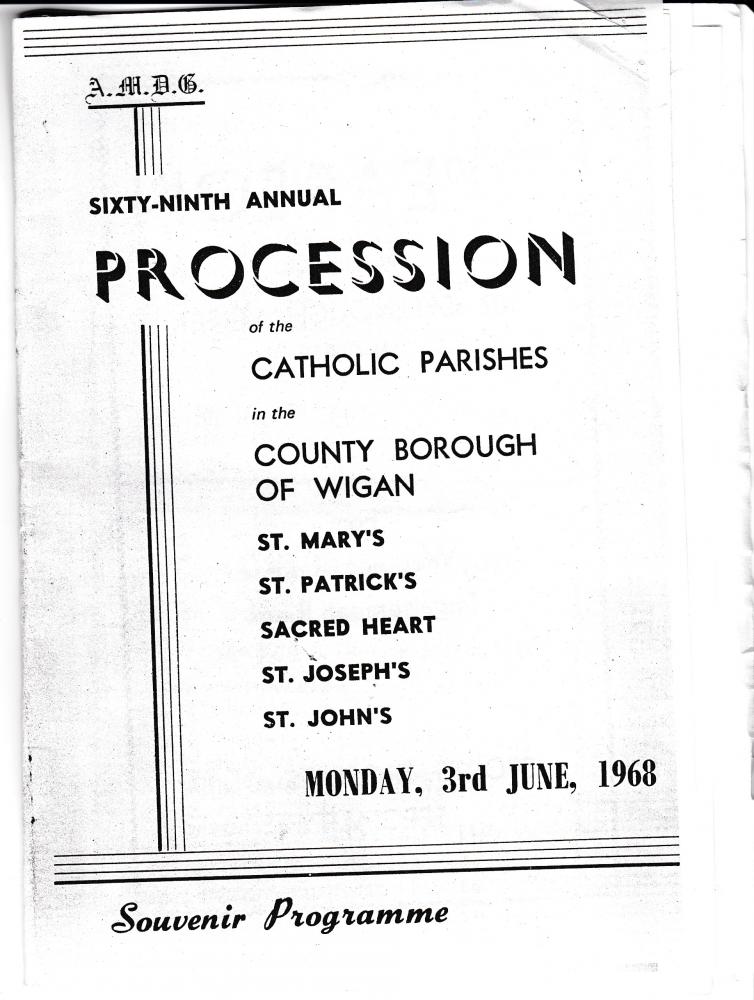
Thanks to WiganWorld for the image
© Who Built Wigan's Churches 2024 - .
All rights reserved.