
Most churches have a war memorial listing names of parishioners who were killed in the two World Wars and subsequent conflicts. There are no definitive ‘rules’ about the names and inscriptions on war memorials. Different criteria for inclusion were used by different parishes, who based names on those born or living in the parish or simply relied on the names put forward by family members.
All parts of society were affected by loss including the families of vicars. Because of their parentage, the lives of clergy sons are usually well documented, and their stories well known. There are a number of such stories in Wigan churches.
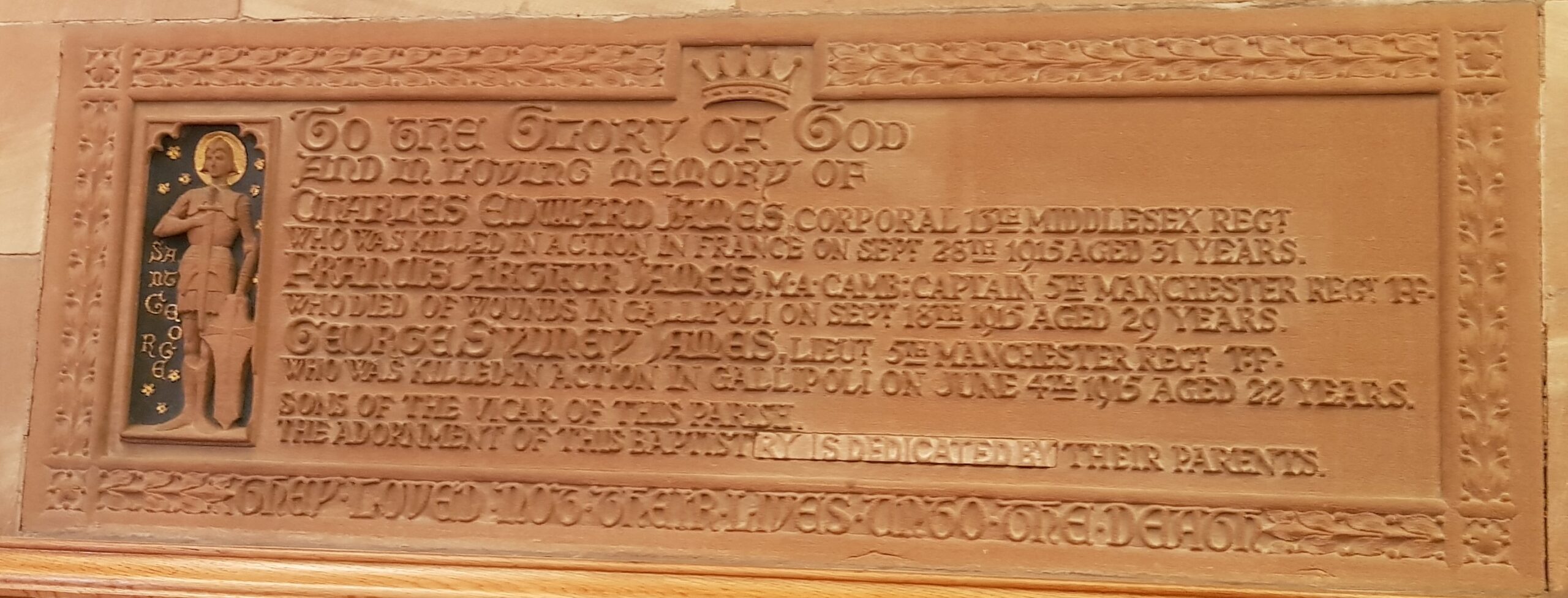
The saddest and most moving example is that of Revd. James and his wife, Emily Maria, who were at St. David’s church, Haigh from 1876 to 1918. Four of their sons died in the First World War with three dying in 1915. In September 1916, the Bishop of Liverpool dedicated the baptistery to the three lads. The day before, Revd. James’s fourth son was reported as missing in action. The four sons are commemorated in the church around the font, their names being beautifully carved in local red sandstone.
The first son to die was George Sydney who joined Wigan Coal and Iron as an apprentice mining engineer. He died on 4 June 1915 aged 22 at Gallipoli and is buried at Redoubt Cemetery, Helles in Turkey.
Francis Arthur became a lieutenant in the Manchester Regiment He died on 18 September 1915, aged 29 also in the Dardanelles. He is buried in Pink Farm Cemetery, Helles in Turkey.
Charles Edward enlisted with the Middlesex Regiment. He was killed on 28 September 1915, aged 31 on the Western Front. He has no known grave and is remembered on Loos Memorial near Lens in France.
These three sons died within four months of each other, from June to September 1915. We cannot imagine how this must have affected the James family in Haigh with Revd. James being expected to ‘carry on’ and support other families in their grief while dealing with his own.
The fourth son, Henry James, was a solicitor and like his brother Charles, enlisted in the Middlesex Regiment. His body was found in December 1917 and he is buried in Quarry Cemetery, Montauban in France.
Bernard Wickham was the son of the Revd. William Wickham and his wife Clara. Wickham was vicar of St. Andrew’s church in Springfield and well known for taking photographs of his parishioners.
Bernard served in the South Staffordshire Regiment and in 1916 he was awarded the Military Cross for gallantry. He was killed at Ypres on 14 April in 1917, aged 22. He is buried in the Railway Dugouts Burial Ground near Ypres in Belgium.
His name appears on the war memorial in St. Andrew’s and on the town war memorial outside All Saints, Wigan Parish Church. A memorial was felt to be needed in St. Andrew’s. The beautiful east window was erected to mark Revd. Wickham’s 38 years as vicar with its top circular light showing God the Father, being a specific memorial to Bernard.
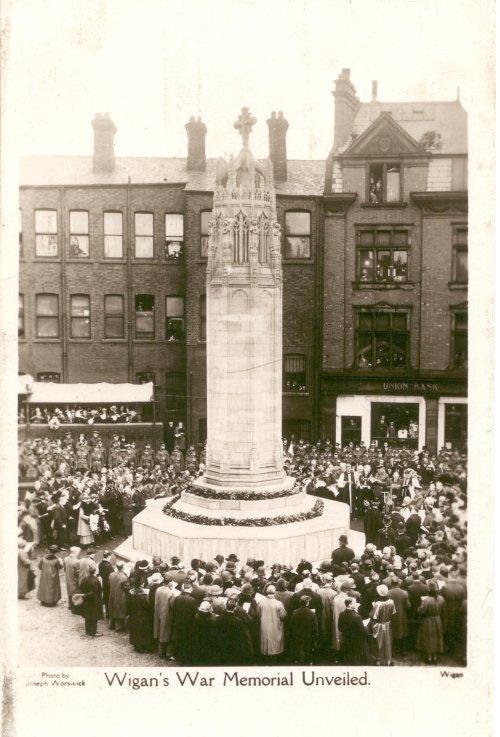
The town war memorial outside the parish church was erected in 1925. For those directly affected, it must have been a moment of great emotion as in that tight enclosed space, the Last Post was sounded, the names of loved ones unveiled.
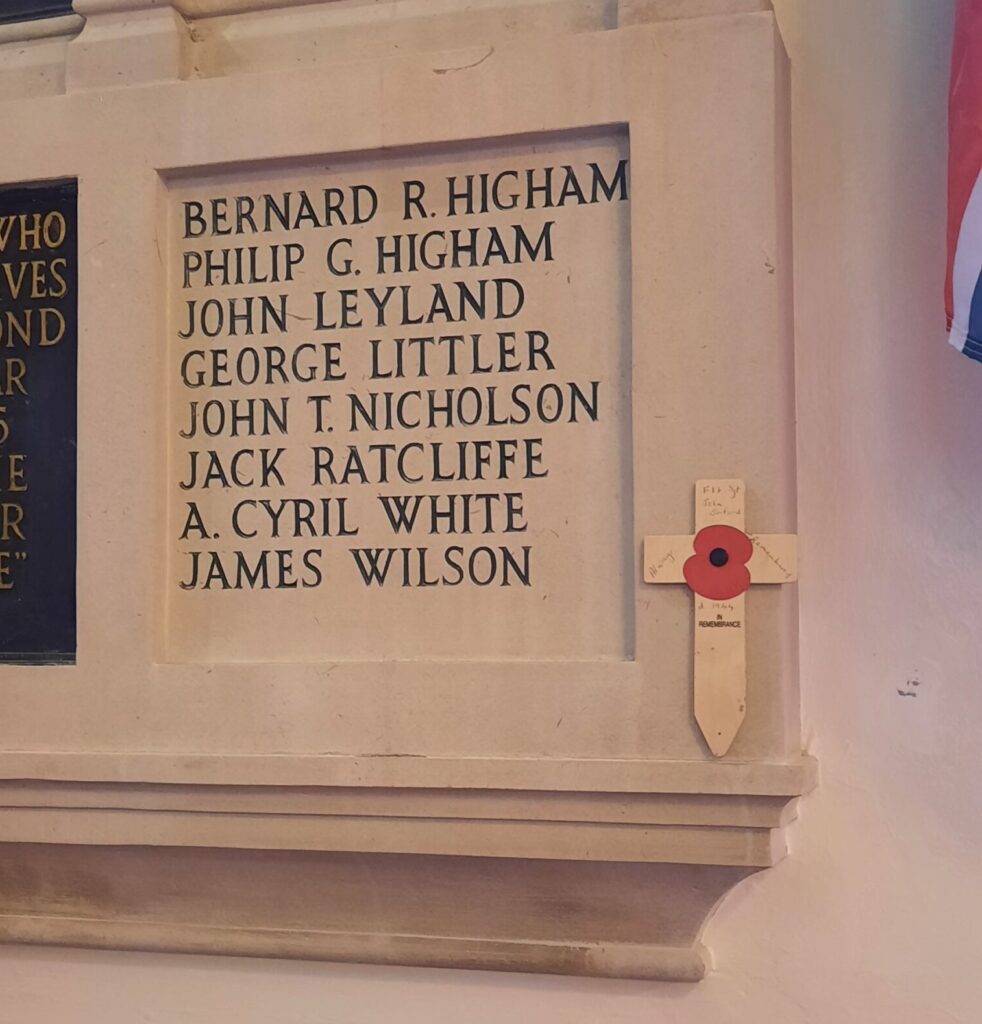
A Second World War death. Arthur Cyril White, son of the vicar of St. Aidan’s in Billinge, Revd. White and his wife Elizabeth. Cyril was born in 1918 in Wigan. He was studying theology at Oxford University when the Second World War broke out and left to join the Royal Air Force. Arthur took part in the Thousand Bomber raid on Germany. His plane took off from the RAF station at Graveley in Cambridgeshire with the target of Cologne railway station. Cyril released the bombs but shortly afterwards his plane was attacked and shot down.
He was 23 years old when he died on 31 May 1942.
His name is recorded on St. Aidan’s Church Memorial and on the family grave headstone in St. Aidan’s church yard.
For this account, we have focussed on sons of members of the clergy. Of course many others, men and women, have lost their lives in conflicts, most far away from Wigan.
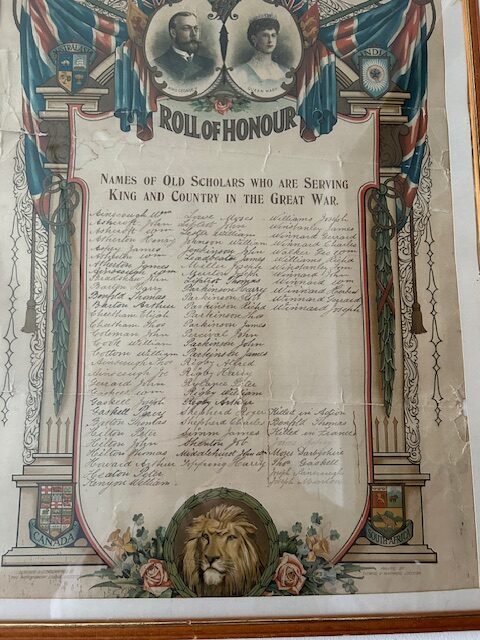
In St. Francis of Assisi church in Kitt Green, there is a handwritten roll of honour which lists the former pupils of Norley Hall School who served in the First World War, six of whom were recorded as having died. Ordinary men such as Moses Derbyshire, a coal hewer, who lived on City Road. His death, along with those of 18 other men, was recorded in the Wigan Observer on 21 October 1916.
We remember them.
Thanks to WiganWorld for the image of the unveiling of the War Memorial
© Who Built Wigan's Churches 2024 - .
All rights reserved.