
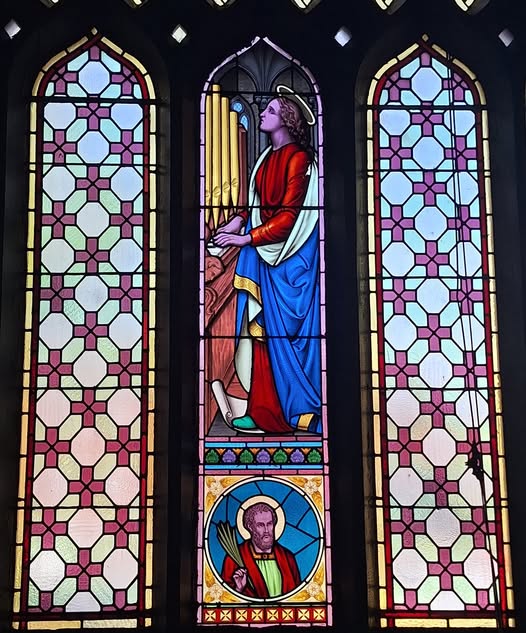
The stained glass windows in St. Mary’s are of great interest to us. The maker’s mark on one of them tells us they were made by W. Gardner of St. Helen’s, a new stained glass manufacturing firm to us. The inscriptions at the base of the windows tell us who the windows are a memorial to and who gave them, opening a new insight into the people of the parish in the second half of the nineteenth century. There is much for us to find out, stories to be told.
But it was when we were leaving the church that we made a discovery which enabled us to uncover a tragic story. The west window is the one you see from Standishgate. Inside the church it is in the vestibule, the entrance where people greet each other and have a quick chat before they enter the church. From the inside of the church you can see that St. Cecilia, Patron Saint of Music, is depicted in the window. Back in the vestibule you have to look hard to read the inscription at the base of the window. It reads:
PRAY FOR THE REPOSE OF THE SOULS OF JAMES MARSH AND JAMES CARTER HEALY, MEMBERS OF ST. MARY’S CHOIR WHO WERE KILLED AT POULTON RAILWAY ACCIDENT 1ST JULY 1893
THIS WINDOW HAS BEEN ERECTED TO THEIR MEMORY BY THE MEMBERS OF ST. MARY’S CHOIR
And there you have it. Two members of the church’s choir killed when a train returning from Blackpool took the tight curve in the railway line at Poulton too quickly and derailed. As well as James Marsh and James Healy, the engine driver, Cornelius Ridgway, was also killed. 42 passengers were injured.
Much has been written about the accident and the circumstances around it. The Board of Trade carried out an inquest into the accident. (Open then scroll down to the bottom of the page.)
In the report the names of the three fatalities are recorded together with those of the wounded. Annie Marsh was ‘uninjured but suffering from shock from death of her husband.’ Charles Healy, James Healy’s uncle, had ‘bruises and cuts about chin, nose and hands.’ Others, a Mrs. and a Miss Noble, for instance, were ‘shaken.’
No mention in the accident report of Wigan. The train, we learn, was due to terminate at Stockport and we assume that was the destination for some of the passengers. So the only tangible visual link connecting Wigan with the accident is the window at St. Mary’s. But there was nationwide coverage of the accident in newspapers and using them, in particular, the Wigan Observer, we can tell the tragic story.
The Manchester Evening News of 7th July gives the details of the deceased. James Marsh of Regent Street, Wigan was 40, James Healy of Swindley (sic) Terrace (actually Swinley Road) was just 14. We learn that the engine was pulling three carriages and a brake van. It was scheduled to leave Talbot Road Station in Blackpool (now Blackpool North) at 11pm. It was the first time that particular train had run that season, perhaps it was a ‘summer special’, and it departed two minutes late.
A week later, The Wigan Observer of 8th July carried a report which tells us much more. The headlines read:
TERRIBLE RAILWAY ACCIDENT NEAR BLACKPOOL
A WIGAN PLEASURE PARTY IN THE TRAIN
The report starts ‘The choir of St. Mary’s Church, Standishgate, Wigan, have for several years had an annual outing and on Saturday they paid a visit to Blackpool to enjoy the yearly treat.’
The choir, we read, caught the 7.15am train from Wigan North Western station on the morning of the crash and it is safe to assume, is it not, that the choir members went on the beach and had a paddle in the sea. If they fancied a treat, Robert’s Oyster Bar had been open for nearly 20 years and the choristers would have known Central and North Pier well, both constructed in 1860s. But everyone must have been keen, on this occasion, to visit South Pier which had opened just a few months earlier and to see Blackpool Tower, then under construction and to be completed the following year, rising above the promenade. ‘The day was a bright one but it was destined to end in tragic gloom. After a full day’s enjoyment, the party made their way to Talbot Road Station, Blackpool, and took their seats.’
The Wigan Observer goes on to report that the train contained about 50 passengers, upwards of 30 of whom were members of St. Mary’s choir and their family members. They all anticipated a quick journey home, first stop Wigan North Western. They were ‘light-hearted and indulged in singing.’ And all went well until the train reached the very tight curve at Poulton which was already a cause of great concern for the railway company, ‘considered to be of a most dangerous character.’ The train was going too fast: whilst there was no specific speed limit imposed it was accepted practice that the curve should be taken slowly. Three quarters of the way round the curve, the train left the tracks, the engine continuing to pull the carriages behind it for a short distance.
The accident is described in the Observer report in great detail. It tells us that the oscillation of the carriages was terrible and that the engine left the tracks very suddenly. Carriage roofs fell in, lamps went out and passengers landed on top of each other. People were trapped with one carriage telescoping into the engine. The noise of the crash could be heard ‘for a long distance’, wreckage was strewn all about.
The Observer goes on: ‘The air was filled with shrieks and moans and piteous cries of help. The horror of the situation was intensified by the steam which was blowing off the boiler. Men and women alike, despite the awful scene, behaved with remarkable firmness and courage, and there were many touching scenes.’
Doctors Winn and Anderson of Poulton were quickly on the scene followed by more doctors from Blackpool. Eight of the injured were taken to Fleetwood Cottage Hospital. Others spent the night in the two hotels in Poulton. The rest, the walking wounded and the shocked uninjured, made the journey home later the same night. What a nerve wracking experience getting back on a train must have been.
From the Observer, we learn more about the two deceased members of the choir. James Marsh a foreman joiner for Messrs. Wilson and Sons, builders of Caroline Street. James Healy, a schoolboy, was the son of Mr. G. J. Healy, J. P., auctioneer of Wigan.
The names of injured are listed with their addresses and their injuries:
Annie and Edith Munro both aged six, perhaps twins, suffered facial injuries. They lived in Orchard Street just across the River Douglas from the church.
J. J. Deady of Brookhouse Street (off Darlington Street East) had a scalp wound.
Michael McMahon, a School Board Member, (no address) had crushed arms.
Four members of the Chamberlain family of ‘Ivy Cottage’ on Wigan Lane. Edwin had a cut on the face. The Chamberlains were then the owners of Chamberlain’s Music Shop also on Wigan Lane (which we, the authors, remember well.)
James Gobin, broken leg, of Marsden Street (off Mesnes Street.)
And so the list continues, giving us a fascinating insight into the congregation of St. Mary’s in 1893.
But there is more from the Observer. The next paragraph is headed:
RECEPTION OF THE NEWS AT WIGAN
THE SCENE AT THE STATION
We’re told that the first Father Walshe, Priest at St. Mary’s, heard about the crash was when he received a telegram soon after the accident from the railway authorities. It read, ‘Sad accident to choir on railway. Marsh and Healy Jnr. Killed. McMahon, Langshaw and Gobin badly bruised. Rest of the choir shaken, but nothing very serious. Break gently to the parishioners. Kelly alright, also Fyans and Howard.’
By the early hours of Sunday 2nd July news had spread and hundreds of concerned people had made their way to Wigan North Western station to meet the shaken survivors. ‘Shortly before the train arrived with the wounded choristers the crowd had swelled out to large proportions. All were on the tiptoe of excitement as to which of the party would be able to make the journey home that morning.’
The inside of the station, we are told, had a ‘very business-like appearance by 12 o’clock midnight.’ The doctors and the nurses had arrived and stretchers for the wounded were ready. The medical men were present, Dr. Cowan from the Railway Company and Dr. Munro, Senior House Surgeon at the Wigan Infirmary. Nurses Spivly (?) and Waring were at the station ‘to render assistance as needed’ and horse ambulances were also present. Fathers Walshe and Heaphy of St. Mary’s Church, together with the Vicar of St. Thomas’s Church in Caroline Street, the Revd. Tebbs, and the Mayor of Wigan, Alderman Phillips, were waiting on the platform.
‘Orders were given at first to clear the station, but this was only partially carried out. It was found to be almost an impossibility to keep out the sorrowing relatives of the people and the platform became fairly crowded. Outside it required a strong posse of police, under Sergeants Newcombe and Fowler, to keep the crowd within bounds and to allow for a passage to the vehicles.’
Telegrams told that the train had left Preston, then Coppull. At 2.10am the train came into view and drew into the platform. The Observer reporter, sadly not named, must have read his Charles Dickens and learned from him how to best to portray tragic scenes. He writes,
‘Those who were injured lifted their pale wan faces to the windows, and one girl in her great anxiety that her people might know that she was safe, feebly waved her handkerchief. Strong men of the party literally broke down after the terrible night’s experience, and parents and daughters were seen weeping tears of joy at meeting again. Tender hands lifted the suffering from the carriages, and on all sides, there was sufficient evidence of the extensive injuries received. Gowns were covered with blood and faces with scars and bandaged hands were numerous.’
Injuries, we are told, were treated in the Ladies’ Waiting Room on the station and thankfully everyone was able to go home in cabs, the ambulances not needed.
The next heading in the Observer reads:
THE NEWS AT ST. MARY’S CHAPEL
Having met the meet the choir members from the train, Father Walshe was back in church for the 8am Sunday morning Mass. At the service he read out the telegram to the congregation from the pulpit causing ‘a great sensation’. He made the same sad announcement at all the other services that day. Mr. James Marsh, he said, had been a member of the choir for over 20 years and he had been a faithful servant. Mr. and Mrs. Healy had lost their very dear son.
There being no choir, the 9.30am and 11am services were abridged and the evening service also had to be changed. The Observer commented ‘Father Walshe and Father Heaphy have been very attentive to the distressed families and administered to all the consolations of religion.’
The next heading reads:
REMOVAL OF THE BODIES TO WIGAN
THE FUNERALS
On Monday 3rd July the bodies of James Marsh and James Healy were brought back to Wigan by train. The train arrived in the evening at 8pm and the coffins were placed on the waiting hearses. The streets were crowded with people showing the ‘greatest sympathy’ and the procession, led by members of the St. Mary’s Young Men’s Society and other young men’s societies, proceeded up Standishgate to St. Mary’s where James Marsh’s body was received into the church by Father Walshe while James Healy’s coffin was taken to his parents’ house on Swinley Road.
The Observer tells us about the scene in St. Mary’s, ‘The Sacred Ediface was crowded. A short service followed, there being no music owing to the enforced absence of the choir.’
The next morning there was a special Requiem Mass in St. Mary’s followed by James Marsh’s Funeral Service. Afterwards members of the St. Mary’s Young Men’s Society carried his coffin to the hearse and processed to Wigan Cemetery where he was buried. Along the route, ‘Blinds were drawn and business people closed their shops’. James’s workmates from Messrs J. Wilson and Son,where he had worked for a long period, acted as bearers. Mrs. Marsh was unable to attend, ‘the shock having culminated the previous night in the general breakdown of the whole system.’
James Healy’s coffin was taken from the family’s house to St. Mary’s on the Tuesday where it remained overnight. ‘A large number of persons assembled in the church and testified their respect and sympathy in a marked manner.’ The following morning a Requiem Mass was celebrated, the congregation including the boys of Cambridge House School (in Preston?) where James had been Head Boy. James was buried at Tonge Cemetery in Bolton where other family members had previously been interred. The pupils of Cambridge House School walked before the hearse as far as the Wigan Borough boundary. Father McFarlane, curate at St. Mary’s, led the service at the graveside. Wreaths were sent by the ‘Freckleton Street Playfellows’, James Healy’s class fellows and Mr. Healy’s clerks who presumably worked at the auction house. James’s parents and siblings managed to attend the service.
We have visited Poulton Library and contacted the Local History Society there. They know a great deal about the accident and its immediate aftermath but were understandably unaware of the Wigan connection and are keen to learn about it.
Three people died. The driver of the train, Cornelius Ridgway is mentioned at length in the official reports. It is for others to research Ridgeway’s involvement in the crash but we know that he was born in 1857 in Poynton in Cheshire. At the time of the accident, he and his wife, Sarah Ann, lived in Gatley. He had been an engine driver for 11 years. His burial record includes the words ‘killed in railway accident.’
It has been a real privilege to tell this story and we hope that James Marsh and James Healy will continue to be remembered. The events of that Saturday night must have scarred the lives of family members in unimaginable ways and the gaps in the choir must have been painful to see for many, many years.
© Who Built Wigan's Churches 2024 - .
All rights reserved.