
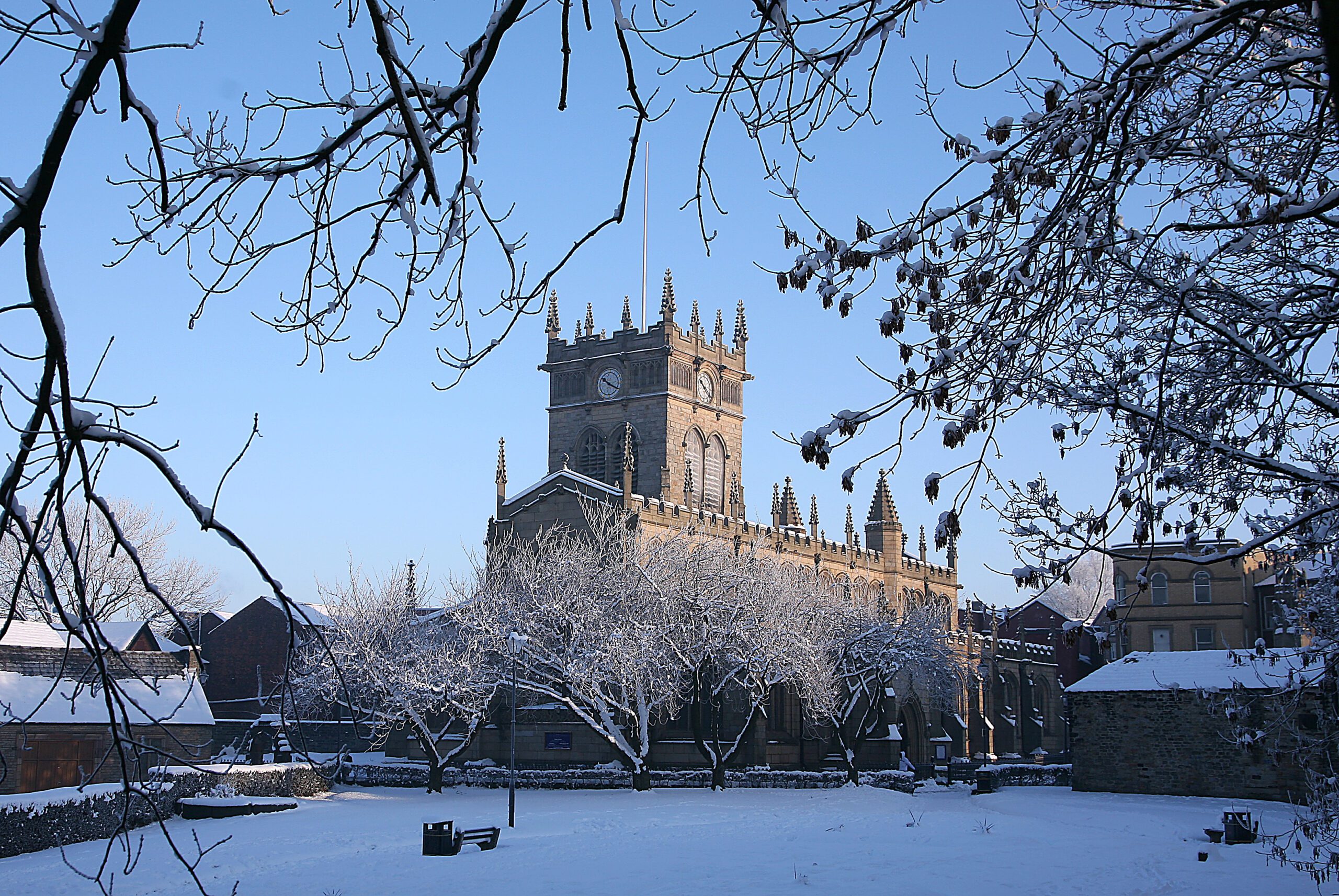
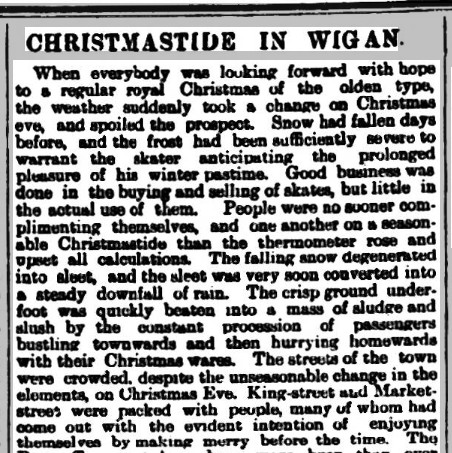
This year we take you back, thanks to the Wigan Observer, to Christmas 1901. Queen Victoria had died earlier in the year and the Boer War was finally drawing to a close. On Christmas Eve Wigan town centre was crowded, King Street and Market Street particularly busy. At 12 o’clock ‘the bells of the old Parish Church rang out their stirring peels over the town to mark the advent of another Christmas morn. The customary house to house visitations were indulged in by the choirs from church and chapel.’
On Christmas Morning commemorative services were held in churches and chapels. The Wigan Observer mentions a place of worship new to us. Wigan Workhouse was on Frog Lane and the research carried out by Wigan Buildings Preservation Trust tells us there was a chapel in the Workhouse. In 1901 over 300 people were living at the workhouse, some of them described as ‘tramps’. We’re told that on Christmas Morning the ‘inmates’ attended the customary chapel service. Perhaps Mr. Joseph Allcock, the Head Official, led the service. We imagine the chapel was basic and spartan, the service serious and solemn. Dinner was served at 12 o’ clock prompt ‘all the viands being served hot on the table. The large dining room was most seasonably decorated, the pillars encased with evergreens and twining flowers.’ What was it really like for the ‘inmates’ and the staff preparing the food? ‘Beer was sent round which was a new feature’.
Meanwhile at St. Thomas the Martyr, Up Holland the bell ringers were busy. They rang a peal of ‘grandsire minors’ in 24 minutes. Quite an achievement for Christmas Morning! There were five ringers and Mr. R Young was the conductor. Present in the belfry was ‘a friend who had not missed visiting the belfry on Christmas Day for 62 years.’
Hope Street Congregational Church on the old Market Square held a Christmas Morning service at 10.45 with carols old and new and a collection for providing ‘Mechanical Blowing for the Organ’.
The Independent Methodist Church in Platt Bridge held its first ‘At Home’ in a packed schoolroom in the afternoon. In the words of the Observer, ‘The school had been tastefully decorated for the occasion and the forms had been replaced by chairs and small tables and when finished resembled the interior of a private residence.’
The musical parts, we’re told, had been very well arranged. Mr. Will Oakden (mimic, conjuror and ventriloquist) of Manchester was everything to be desired, prompting roars of laughter at every appearance. Refreshments and teas were provided and ‘this was one of the most pleasant gatherings ever held there.’
A couple of days earlier the Christmas Smoking Concert (men only) had been held at the clubroom of St. Oswald’s Catholic Club in Ashton. Revd. Father O’Meara as president was supported by Revd. Dr. Bennett and Mr. Peter Roberts, chairman of the club. The prizes won in the recent billiard handicap were presented by the chairman. Vocal and instrumental items were contributed by the members, Meesrs. V. Riley and W. Dooley proving able accompanists on the piano.
Elsewhere, away from churches, the Observer tells us that on Boxing Day ‘Messiah’ was to be performed at the Drill Hall, band and chorus numbering over 200. Ticket prices ranged from 6d to 2s and 6d, available from Grime and Sons, King Street.
Over the Christmas period The Wigan War Fund met to organise the distribution of the Christmas Allowance Fund to families with men fighting in South Africa.
Annoyance was expressed in the newspaper that Wigan Rugby Club had travelled all the way to Birkenhead only to be told that, the pitch being frozen, their match was called off.
The Mint, a shop at 182 & 184 Scoles, had a Grand Display of Christmas and New Year Presents (good, warm winter clothing, army boots and linoleums) and was accessible by electric cars (trams?) ‘Ask the Conductor to drop you off!’
© Who Built Wigan's Churches 2024 - .
All rights reserved.