
In most Wigan churches there are beautiful and dignified War Memorials erected in the early 1920s to commemorate the dead of the First World War. The names of those who died in the Second World War and in later conflicts have often been added later. The town’s monumental War Memorial outside All Saints, the Parish Church, designed by Giles Gilbert Scott (who was the architect of Liverpool Cathedral) is architecturally of national importance.
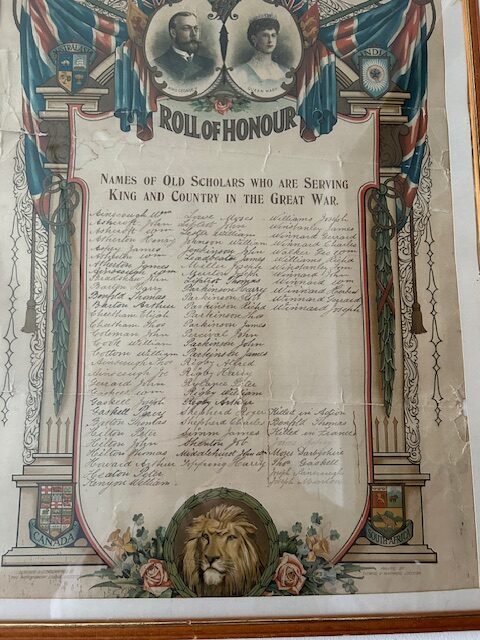
At St. Francis of Assisi church in Kitt Green, though, there isn’t a grand stone or wooden memorial. But hanging on the wall there is a ‘Roll of Honour’ with 72 names recorded in beautiful old fashioned handwriting,
It’s described in great detail on the Imperial War Museum’s online registry of War Memorials.
There you can read about the portraits of King George V and Queen Mary, a laurel wreath and the Coats of Arms of the countries of the Empire and, of course, you can visit the church to see the Roll for yourself. It is indeed ‘commercially produced’ as so many other Rolls of Honour must have been but what caught our attention were the words: “Names of old scholars who are serving King and Country in the Great War”.
Two things struck us. The Roll of Honour was initially a focus to think about the men who were then serving, to remember those fighting on a ‘foreign shore’. Only later as devastating news reached home were the names of the dead recorded.
And scholars. But of which school? No one seems to know for sure, but the origins of today’s church began when the Day School, the buildings of which are still used today, was opened in 1873 having been paid for by the owners of Norley Colliery. As far as we can tell, it remained a Day School until about 1920 after which it continued in use as a Sunday School.
So the ‘lads’ on the Roll of Honour may well have been taught and attended assembly in the rooms where now coffee and cakes are shared after services. They had, of course, no idea as schoolboys what horrors they would experience in just a few years’ time.
At the bottom is a group of six names under the heading ‘Killed in Action’. Thomas Benfold is one of those men and we want to share his story with you.
Thomas was born in Orrell and was baptised at St. John the Divine church in Pemberton on 21 April 1892.
The 1901 census tells us he was living, aged nine, in Spring Road, Orrell with his father, Thomas, and mother, Hannah. He was one of six children all described as ‘Scholars’ maybe at the Norley Colliery School.
By 1911 he had moved to 326, Woodhouse Lane where he was living still with his parents but now with four sisters and four brothers. Nine of them altogether! His sisters’ occupations included glue packer in a chemical works and a cook. Thomas himself and his older brother were both listed as miners while a younger brother, aged 13, was described as a pitboy.
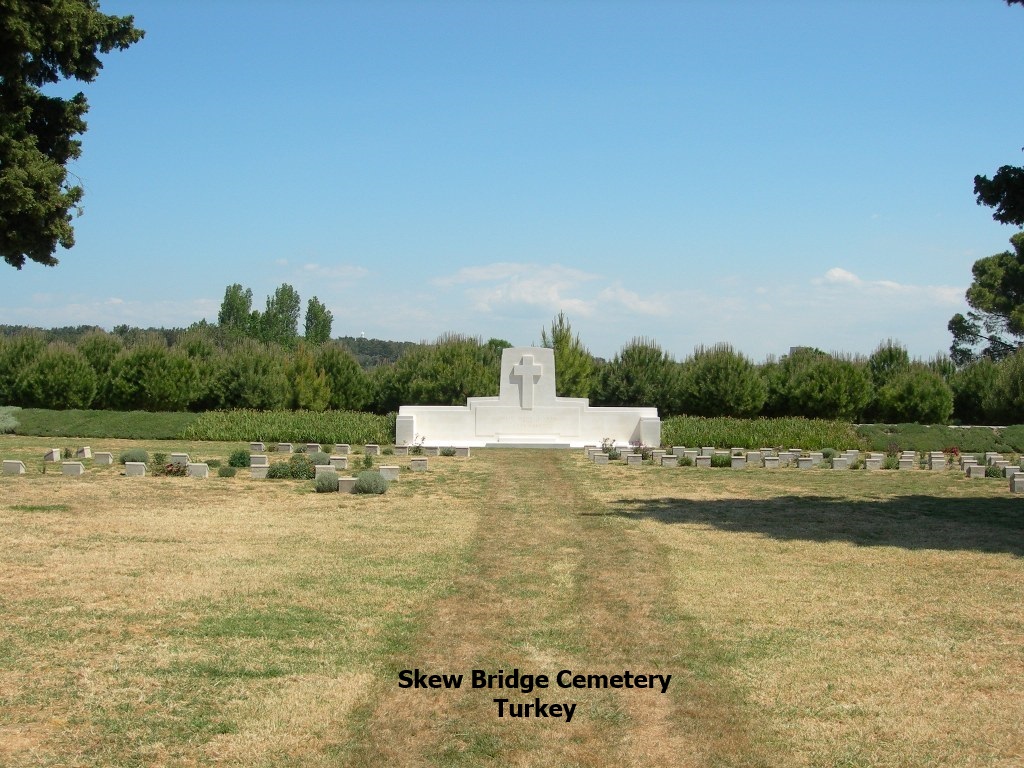
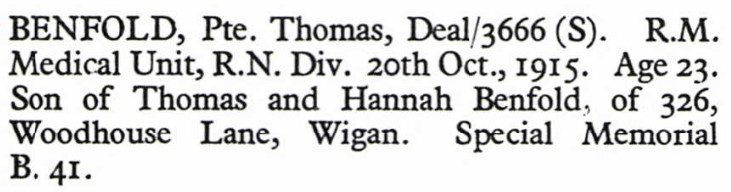
Thomas was ‘killed in action’ on 21st October 1915 whilst serving in the Gallipoli Campaign in Turkey. He is buried there in the Skew Bridge Cemetery where over 600 soldiers are buried. He was part of the Royal Marines Medical Unit Royal Navy Division.
We have a moving description of Thomas’s death, told with great affection by his good friend, Private Richard Banks. The account is addressed to Thomas’s family giving it greater poignancy. Banks was serving in the Field Ambulance of the Mediterranean Expeditionary Force and Thomas was probably similarly occupied. Before the War, Banks lived at 78 Clayton Street, Wallgate. He appears to have ‘joined up’ to fight with Thomas.
Banks’s account appeared in the Wigan Observer on 13th Nov 1915. Thomas was a stretcher bearer and he worked with another Thomas, Thomas Yeomans.
Banks writes, “Your son Thomas, died in the execution of his duty, and he died a hero’s death. He gave his life to save a comrade. He left camp at 7.30am on Wednesday morning, quite cheerful and happy and was going up to our Advance Dressing Station called ‘Pink Farm’. The stretcher bearers convey the wounded from the regimental aid post to the Dressing Station. They had just got into the reserve trenches, and put their overcoats and haversacks down, when Tom and a chap named Tom Yeomans were called to take a man down to the station, he having been wounded in the head. They had the stretcher on a litter, Tom at the front end and his mate at the back.
There were some troops going across the open in massed formation, and the Turks seeing this, started sending the deadly shrapnel. His mate tells me they were going at pretty good pace to get the wounded man to the dressing stations to be attended by the surgeon.
Then all at once Tom stopped, turned round and looked at him, and got quietly down and stretched himself out. His mate tells me he did not think it was anything serious and the only words he muttered were “Oh, dear”. As he got down, he crossed his hands on his breast and fell asleep. It was over in less than a couple of minutes.
His mate ran for the surgeon who had just finished fastening a tourniquet on a man’s leg which had been badly damaged by the shrapnel and said to him “Surgeon Calthrop, Benfold’s got done”. The surgeon picked up his haversack and ran off, Tom’s mate following him, only to find that Tom had passed away.
This was about 8.45am last Wednesday morning. He was taken to the dressing station and sent down to the hospital at the bottom of camp. A fellow came and told me that my pal had got injured, so I ran down to the hospital to meet the motor ambulance wagon, and after waiting about ten minutes, the wagon came, but when I saw him, it brought tears to my eyes, to think that I had lost my best pal.
He was laid to rest at five o’clock in the R. N. D. Cemetery, Orchard Gully. The Sergeant Major sent for me and told me that I had charge of the funeral arrangements, with being his particular pal, and he sent a digging party to dig his grave. He was borne to the cemetery by the lads of Wigan and Hindley, St. John Ambulance Brigade.
He was buried by the Army Chaplain and there were about forty of his comrades stood round the grave to witness the memorial service. You can rest assured that he had a good military funeral, and he is now at rest on Gallipoli peninsula, the battlefield where thousands of heroes have fallen.“
Banks goes on to list Thomas’s belongings which he intended to return to his family. They included a prayer book, a pay book with 6s drawn from July 1st and his pipe which had been sent from Liverpool by his brother. Banks packed the envelopes with the letters he had received from home. One packet contained the letters he had received from his young lady, Miss E Danson, the other the letters he had got from home.
Banks continues: “We were old chums in the Brigade and we stuck to each other like glue from the very morning we left Wigan to go to Manchester to be sworn in and we have never been parted until now.
I might tell you, if you have a service at St. Andrew’s, there were two of his favourite hymns we used to sing nearly every evening at Blandford and coming across on the ship. They were “The Day Thou Gavest Lord is Ended and “Nearer My God to Thee”. He used to delight in singing them.
I must now close as I don’t want to cause you any more pain after what you have endured. I hope you will bear up as best you can. My deepest sympathy goes to his loving father, mother, sisters and brothers: also his friends and relations – Tom’s true and best pal, Dick.”
It looks like Richard Banks survived the war and married Ellen Critchley at All Saints, the Parish Church in 1922. He died in Standish in 1978.
We have not managed to trace Miss E Danson.
Thomas’s name is listed on both Wigan Town Centre and St. Andrew’s Church War Memorial in Springfield. The Wigan Observer article tells us he was a Sunday School worker at St. Andrew’s.
We remember him together with all the other servicemen and women whose names are recorded on memorials all over the Wigan area.
© Who Built Wigan's Churches 2024 - .
All rights reserved.