

All Saints Hindley is a real treat. Nowhere else do you feel so close to Wigan in the eighteenth century, at the start of the industrial revolution. One of the graves outside is marked Martha, John and Ann Southworth who died in the 1740s and you wonder what Hindley was like then, what their lives were like.
First known as Hindley Chapel when founded in 1641, it was already 100 years old when the Southworth family was laid to rest. It was a ‘chapel of ease’ to All Saints, the Parish Church in Wigan, built to enable people who lived some distance from the church in Wigan to attend services closer to their homes. There are different opinions as to the date it became a parish in its own right.
The early history of Hindley Chapel warrants an article of its own. For now we will look at the church we can see today. By the 1760s the walls of the original chapel were, ‘so cracked and bulged….that the inhabitants are afraid of assembling therein for divine worship’. It was also too small for the rising population so the Bishop of Chester issued a faculty to take down the chapel and rebuild it on a larger scale. The first service in the rebuilt chapel was held on Easter Sunday 1767.
It is a simple building with tall arched windows and a cupola which contains a single bell. A top lunette window at the west end lights the roof space while there is a larger window above the altar at the east end. Described as a delightful chapel, it is built from local handmade bricks. It reflects the religious thinking of its age when sermons preached from the pulpit were seen to be more important than communion at the altar. The vestry and parish room were added in the 1930s.
Three men were ‘managers’ of the 1767 rebuilding: Peter Marsh, Charles Ditchfield and one James Eckersley. Eckersley was described as a wealthy landowner and was an ancestor of the mill owning Eckersley family of the nineteenth century. His descendants, Nathaniel and James Carlton, went on to pay for other churches in Wigan.
The church graveyard is surrounded by an old stone wall. Most of the old gravestones were removed in 1968. Significantly the ones that remain are those of the prominent Eckersley and Leyland families whose role in Hindley’s history was so important. The church is now set in the middle of a well-kept green lawn, a world away from the busy town centre and the traffic on Atherton Road.
Inside all is light and bright. There are the original eighteenth galleries on three sides supported on slim iron columns, a shallow chancel (not designed for choirs) and a simple flat ceiling.
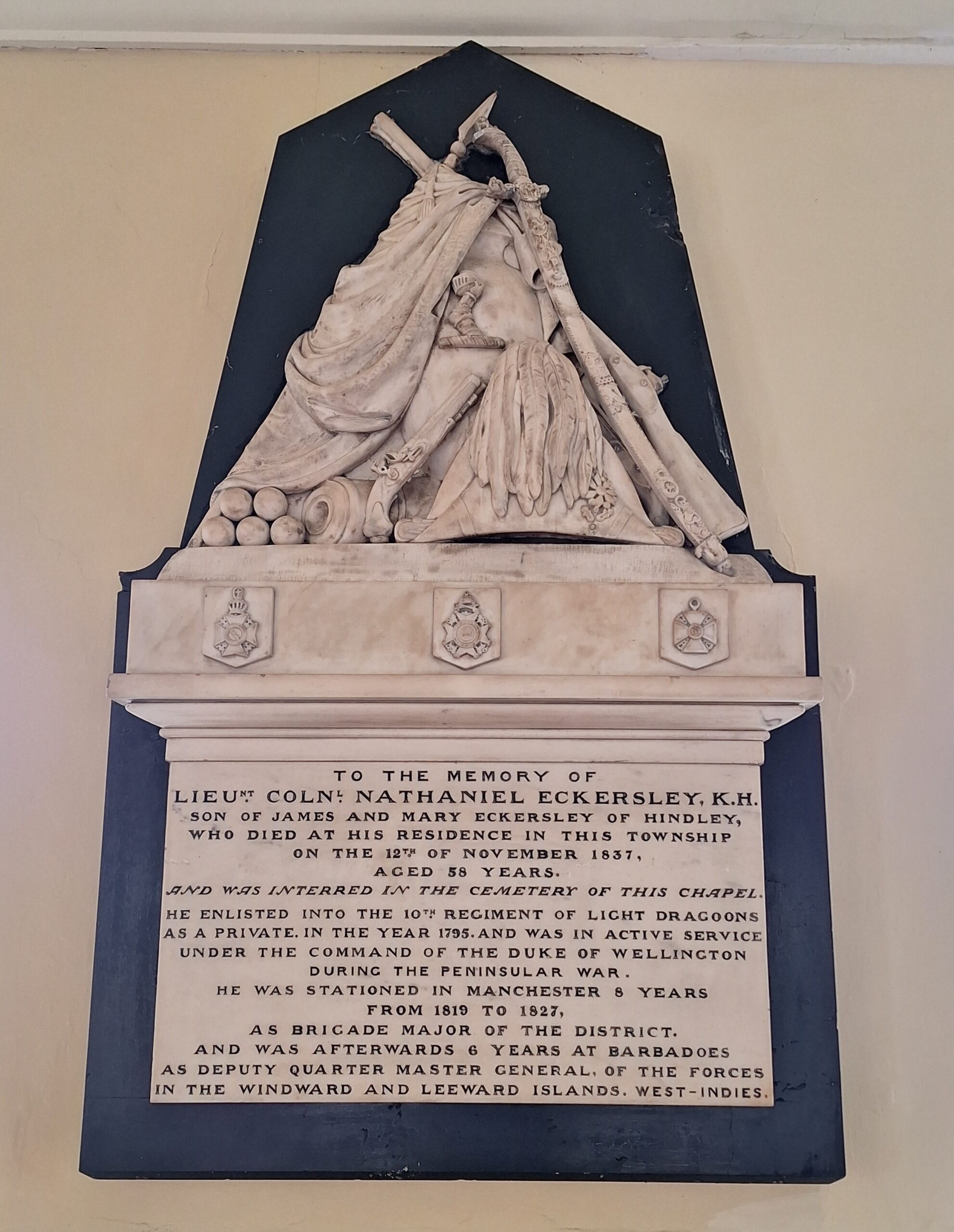
There are five memorials in the galleries. With the memorial to Elizabeth and Ralph Peters of Platt Bridge we are again taken back to the eighteenth century. They were both born about 1730 before the canal, let alone, the railway came to Wigan. The Eckersley family are present, of course, with a memorial to Lt Col. Nathaniel Eckersley who died in Hindley in 1837 having fought in Spain under the Duke of Wellington.
There is an octagonal Victorian font. Nothing unusual about that but the one here is made from wood rather than the usual stone. It was given in memory of Emily, Eliza Annie and Ellen Johnson who died young, sister and daughters of James Henry and Elizabeth Johnson. James owned Abram Coal Company and St. James and St. Elizabeth’s church in Bickershaw was built in his memory. Like the Eckersley’s, the Johnson family are key characters in the story of who built Wigan’s churches.
The war memorial is at the end of the south aisle and includes a Falklands Conflict victim.
But it is the stained glass that catches the eye. The east window is beautiful. Modern, it lets in light and proudly depicts four Northern saints either side of Christ in Majesty. Made by Powells of London, their maker’s mark, a Whitefriars’ monk, is visible tucked away in the corner. The maker’s mark recalls the fact that their workshop was in an area of London known as Whitefriars where there was once a monastery. There’s also glass made much nearer to home. In the mid-nineteenth century a certain W. Gardner of St. Helen’s made the glass in one of the windows of the north aisle.
Another window commemorates Henry and Ellen Southworth and John Scowcroft. Those names rang a bell. Old histories of St. John’s, Hindley Green tell us that John Scowcroft and his wife Mary provided a room over the old Post Office in Hindley Green for use as a school in the 1850s. Mary is remembered in the histories as a Sunday School teacher and we’re told that the children processed from Hindley Green to All Saints for services on Sunday mornings. Members of the Southworth family are also mentioned in the history of the church in Hindley Green.
The Springs Colliery Disaster of 1868 when 62 men and boys died is remembered by a modern memorial in the churchyard. Churches were the focus for people’s grief on these tragic occasions. There is a moving account of the funerals of the deceased at All Saints and it reminds us how awful these events were not only for the families but for the vicars who had to take the funerals.
Before the mid-1800s most churches in Wigan had ‘rented’ pews which families owned outright or were rented for a fee to wealthy parishioners. The money raised usually helped to pay the vicars’ wages, their stipend. All Saints still possesses the pew plan (undated) which shows all the pews and the names of the people who occupied them. There we see the names we are so familiar with in the history of Wigan’s churches: the Eckersley’s, Roger Leigh, Richard Pennington and John Leyland and other intriguing names such as Bridgewater Trust and De Trafford which we will be investigating over the next few months.
We want to mention John Lowe. He was Headteacher of Mornington Road School and a long-standing churchwarden. He was also a ‘proper historian’ and in 1991 wrote a detailed history of the church which we will be using to write more about the history of this fascinating church. He used long forgotten manuscripts found tucked away in the church chest (now in Wigan and Leigh Archives) and old churchwardens’ accounts. He did an amazing job giving us a valuable insight into the history of All Saints.
With St. Aidan’s, Billinge, All Saints in Hindley takes us back to a Wigan of an earlier age before canals, railways and large cotton mills and that makes it all the more precious.
And finally, we said we would leave writing about the first chapel, the one built in 1641 for another day. But we do need to say something. Have a good look at the bell beneath that lovely cupola. You would assume that it dated from 1767 when the church was rebuilt. Not so. The date 1646 is clearly inscribed on it so with that bell we are taken even further back, to Hindley during Civil War when the township was in ‘no man’s land’ between Royalist Wigan and Puritan Bolton, the chapel at that time being firmly in the hands of the Presbyterians. But that is a story for another day.

© Who Built Wigan's Churches 2024 - .
All rights reserved.