

There is some fascinating stained glass in Wigan’s churches and we want to make it better known. Many people were involved in putting stained glass windows into churches. People paid for them, people designed and then actually made them and others did the difficult job of fitting them into the window space. So far, we’ve researched the stained glass in All Saints, the Parish Church and, as its open on Saturday mornings until September, you can go and see it for yourself.
The earliest stained glass in Wigan is in the Walmesley Chapel in in the Parish Church. It probably dates from the early 1500s. It depicts figures of saints and symbols of Christ’s crucifixion. The church in medieval times would have been full of glass like this. Much of it would have been deliberately destroyed in the Reformation in the sixteenth century or during the Civil War when the Royalist troops in the church were besieged by the Parliamentary soldiers. After that, the art of making proper stained glass windows was lost for centuries.
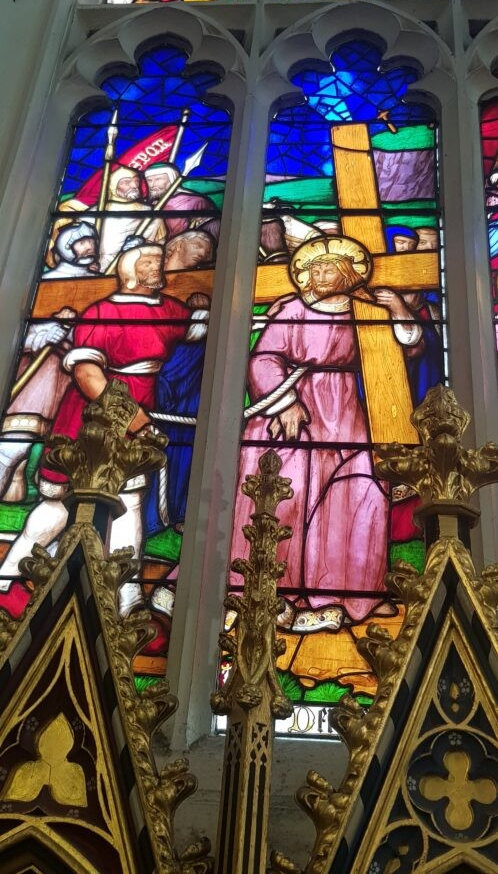
It was during Queen Victoria’s reign that stained glass was made again. The first new window in the Parish Church, the one above the altar, was installed in 1847 and shows scenes from the life of Christ. When the congregation first saw it with all its vivid colours, it must have been like seeing a colour TV or 3D cinema for the first time.
The church’s most famous window was designed by Edward Burne Jones and made by William Morris’s firm. It shows St. Christopher carrying the Christ Child. If you look carefully at the window, it is more sophisticated than the others. St. Christopher looks much more active (not facing forwards) and the water is made up of different shapes of glass to look more realistic. It has none of the old fashioned canopies which other windows have.
The window, given in memory of Edward Scott, a 64 year old lawyer who lived at Beech Hill Hall, was donated by his 28 year old wife, Laura.
By 1868 Morris and Co were working from a house in Queen Square in Bloomsbury, London. There they had an office and showroom and, at the back, workshops and a small kiln to fire the glass. The small pieces of glass, having been fired, would have been put together using leading into larger panels and then transported to Wigan presumably in crates by train. Glaziers then installed the panels here in the church hoping all the measurements sent to London were correct and the complete window fitted perfectly.
Members of the Crawford family who, of course lived at Haigh Hall, are commemorated in two windows in their own chapel, the Crawford Chapel.
The most interesting one is the window in front of the chapel’s altar put there in memory of the 25th Earl Alexander Lindsey who died in Florence in 1880 and whose body was famously stolen before being reinterred in the vault below the Crawford Chapel. It was designed by his youngest daughter, Lady Jane Evelyn Lindsay, an accomplished artist. It depicts four saints and illustrations of baptism, confirmation, ordination and matrimony.
Other windows in the Parish Church were given by Wigan’s wealthy families, the Thicknesses and the Woodcocks, who are so important in the history of other Wigan churches.
Elsewhere in Wigan, there is of course, stained glass made in St. Helen’s, charming 1950’s windows (check out the sensible shoes!) depictions of the mining industry and modern glass by some of the country’s finest stained glass artists. We look forward to telling you more.
© Who Built Wigan's Churches 2024 - .
All rights reserved.