
The Methodist Church came into being during the eighteenth century. Its leader was Revd. John Wesley who wanted the church to return to simpler principles without, for example, bishops and big cathedrals. He preached sermons in the open air and toured the country on horseback. He visited Wigan several times. His first visit was in 1764. In his journal he wrote, “At 10 I began to preach at Wigan proverbially famous for its wickedness. As I preached abroad (in the open air) we expected some disturbance. But there was none at all. A few were wild at first, but in a little while grew quiet and attentive. It was a very civil congregation”. Many people in the town liked what they heard, “the methodical way in which Methodists carried out their Christian faith” and Wesley soon developed a following.
Wesley hoped the Methodists would remain within the Church of England but the differences between the two denominations became deeper and separate Methodist places of worship began to be built.
The first Methodist chapel in Wigan was opened by Wesley himself in 1775. It was in the yard of the Buck-i’-Vine off Wallgate and on the day of Wesley’s visit had no roof, his sermon given in the middle of a thunderstorm.
Searching Methodist Churches on WiganWorld gives a good idea of the large number of Methodist places of worship there have been in the Wigan area. We are struck by the closure and recent demolition of Gidlow Methodist Church in Walkden Avenue and want to get the ball rolling to research and celebrate Methodism in Wigan.
Our mum and her extended family were Methodists and attended Standishgate Methodist Church. They moved, with mixed feelings we remember, to Whitley Methodist Church in Spencer Road when that church opened in 1974. It was a bold decision, spearheaded by Revd. Cyril Cornah, to move from a town centre church to a site near new housing with a car park! Whitley, with other Methodist Churches in the area, continues to fly the flag for Methodism in Wigan and its dual purpose building, a church and a hall, serves the community well.
But let’s return to the town centre. We’re at the very start of our research so additional information would be most welcome. We want for now to highlight three churches: Standishgate, King Street and the Queen’s Hall.
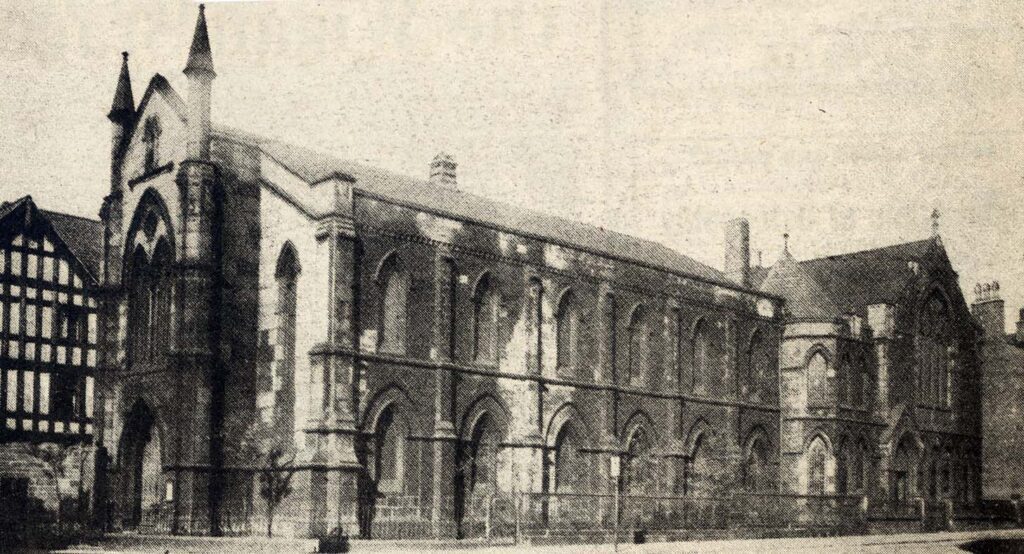
The three churches were very different from each other. Standishgate, opening in 1845, from the outside resembled St. Catharine’s in Scholes, built around the same time. It did not have a spire but was stone built with the same narrow pointed windows as St. Catharine’s and had a distinctive front with two turrets facing onto busy Standishgate. We’re told in detail about the laying of the Foundation Stone. A hermetically sealed bottle containing a written parchment giving details of the event was buried at the same time. 16 special sermons were preached to mark the official opening.
The church was roughly where Iceland is situated now and was demolished in the early 1970s. The Methodist School stood across the road in Dicconson Terrace and the playground where our mum and later Sir Ian McKellen played as children is now somewhere beneath the dual carriageway. We look forward to saying more about the life of the church in more recent times. Open days as the church’s tennis club in Whitley were a real highlight.
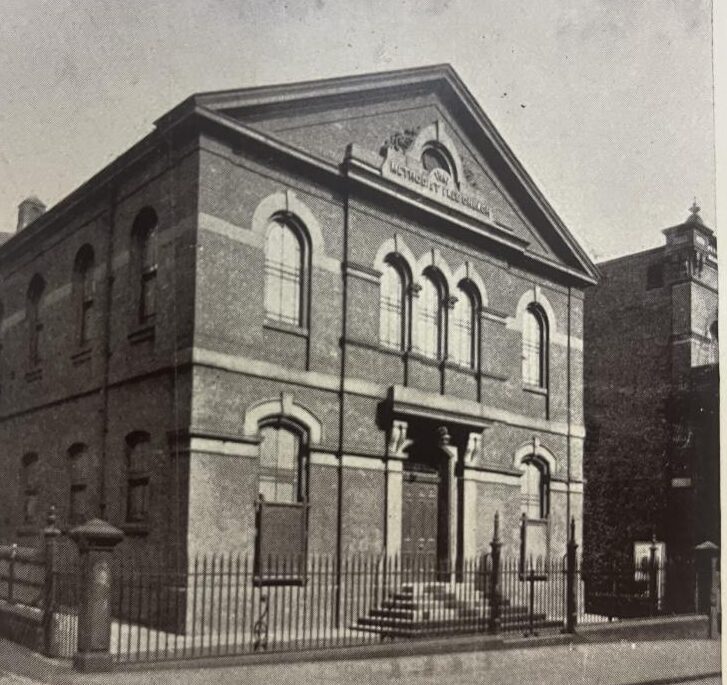
King Street Methodist Free Church appears on the Wigan Buildings Preservation Trust website (WBPT). Opened in 1868, it was a grand chapel building, more classical in style than Standishgate, with round headed windows on two levels (church above, school and meeting rooms below) and a pediment, a triangular top above, the date of opening and the words Methodist Free Church proudly carved. Keeping the church clean seems to have been an issue with a special service in 1892 listed in the Wigan Observer as the ‘Re-opening Service after Cleaning and Alterations’ and in 1913 a three day ’Japanese Bazaar’ taking place to pay for the cleaning and redecoration of the church. There were, don’t forget, two busy steam train lines close to the church! King Street Methodist Church was demolished in the 1960s and its site is now Morty’s Night Club.
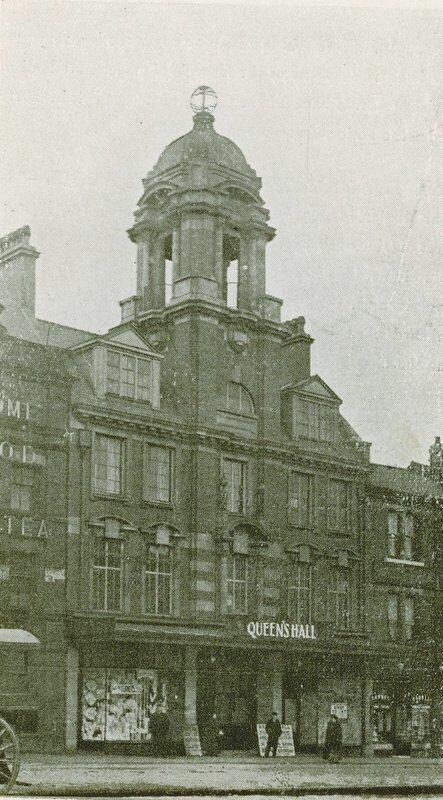
Finally, the Queen’s Hall Methodist Mission in Market Street, opening much later in 1908, the first decade of the twentieth century. Those of us fortunate to remember the ‘old’ Queen’s Hall recall how different it was. The fine Edwardian baroque frontage and tower remain but the interior, with the curved ‘circle’ upstairs, the tip up seats and the mysterious chambers downstairs was remarkable. It was a very different type of church building, of a much later time than the other two churches, a Mission Church hoping to attract different people at a time when the world was changing quickly, the old ways starting to be questioned.
The Queen’s Hall, in some ways resembled a theatre, even having a ‘crush bar’. It was always intended to be used for concerts and other events including Wigan Girls’ High School Speech Days as well as church services. It was deliberately designed to have shops on either side of the entrance to raise money through rents and was entered directly from the street. No churchyard, railings, steps or gateways. It was almost as if it was just another building on Market Street. And, of course, it still provides an invaluable service today being the place where ‘The Brick: Queen’s Hall Action on Poverty’ initiative, a charity which supports many people in the town today, began.
We’ve heard there was a Primitive Methodist ‘Central Hall’ on Station Road. On the WBPT website is fascinating information about the Independent Methodist Churches in Wigan, the church in Greenough Street being their first. We have an intriguing photograph of the building of the iron church which we think preceded Gidlow Methodist Church on Walkden Avenue. St. John’s Methodist Church in Hindley is a landmark you can’t miss.
Let’s mark this rich history together. We will post again when we’ve learnt more but if you can tell us more please use the Contact Us page and we will get back to you.
The Queen’s Hall opened in 1908. It’s interesting to compare this with St. Nathaniel’s church in Platt Bridge which was built around the same time.

© Who Built Wigan's Churches 2024 - .
All rights reserved.