
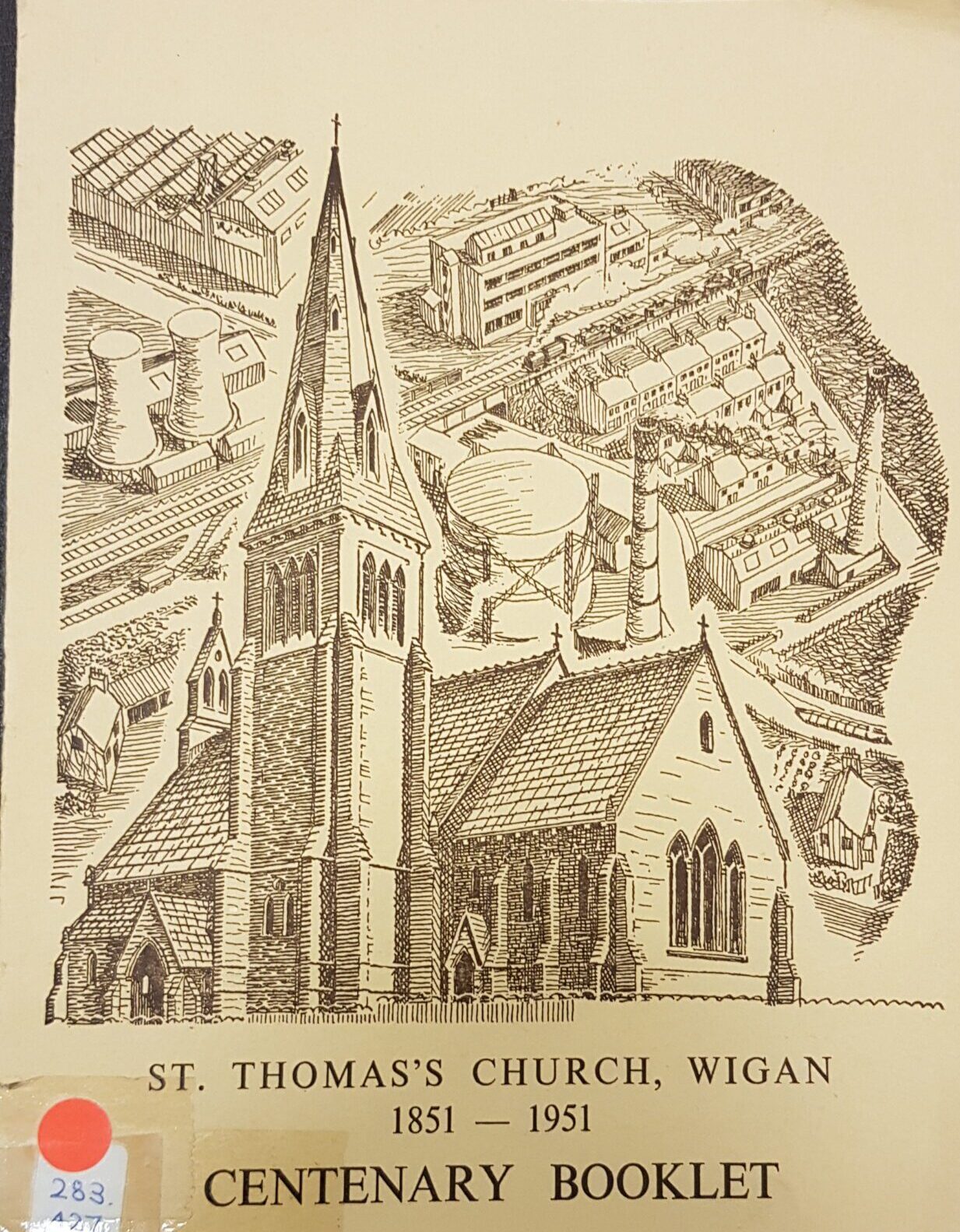
St Thomas’s Church in Caroline Street, one of the streets south of Wigan North Western station, was consecrated in 1851 and demolished in the 1970s. Photographs of the church show it was stone built with a nave and two side aisles. Its tower and spire must have dominated the skyline in that part of town in the same way St. Catharine’s spire does in Scholes. Its proximity to St. Joseph’s Roman Catholic church is striking and you wonder how, in the nineteenth century when denominational differences were more problematic, the two congregations related to each other.
The chosen style was simple Early English (that is plain pointed arches and windows). This style was fashionable at the time and had the advantage of being fairly cheap. A sum of £2,404 had been the first estimate for a church of 749 ‘sittings’, but the plans were modified several more times to reduce the cost. As photographs of the interior show the proposed shallow chancel was not built and a curate from All Saints, the Parish Church, Revd. Simmons, borrowed £500 to pay off the church’s debt. The architect was Mr. John Hay and the clerk of works, Mr. Thomas Ellis. The cost of the completed church, with fittings, rose to £4,719. The then Rector of Wigan, Revd. Gunning was chairman of the Building Committee set up to build the new church so unsurprisingly he must have played an important role in getting St. Thomas’s built.
The 1951 Centenary Booklet then goes onto describe the church. We are told that when it was built every available inch of space was laid out in pews (expecting a large congregation!). A ‘thinning out’ process went on which, the booklet says, greatly improved the appearance of the interior. The lack of a chancel had the advantage of enabling the church to foster the congregational aspect of worship and to emphasise the ‘openness’ of the services. The church had seven stained glass windows, the last to be added being that of St. Thomas on the south aisle. The east window must have been interesting. It was the oldest window, depicted the Resurrection and was designed in Belgium.
The booklet describes the Parish of St Thomas’s as it was in 1951 like this: ‘St. Thomas’s is a typical ‘downtown’ parish. The boundaries are fixed by the canal and railway lines, and within its boundaries are two railway stations, the gas works, the electricity generating stations, and numerous mills and factories. In this busy industrial setting, ringed by the tall factories, the spire of St. Thomas’s rises as a witness to God and the religion of Jesus Christ’.
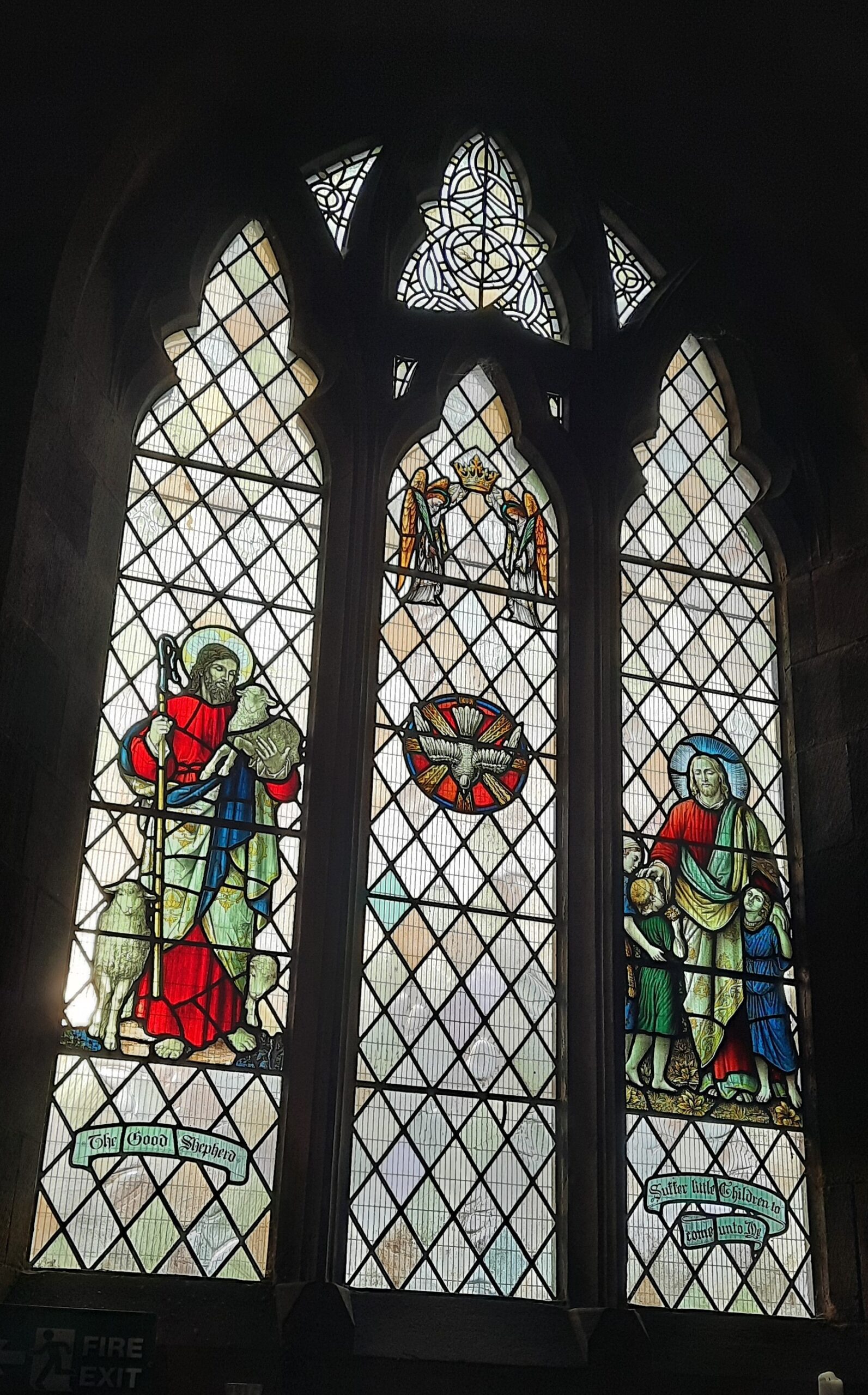
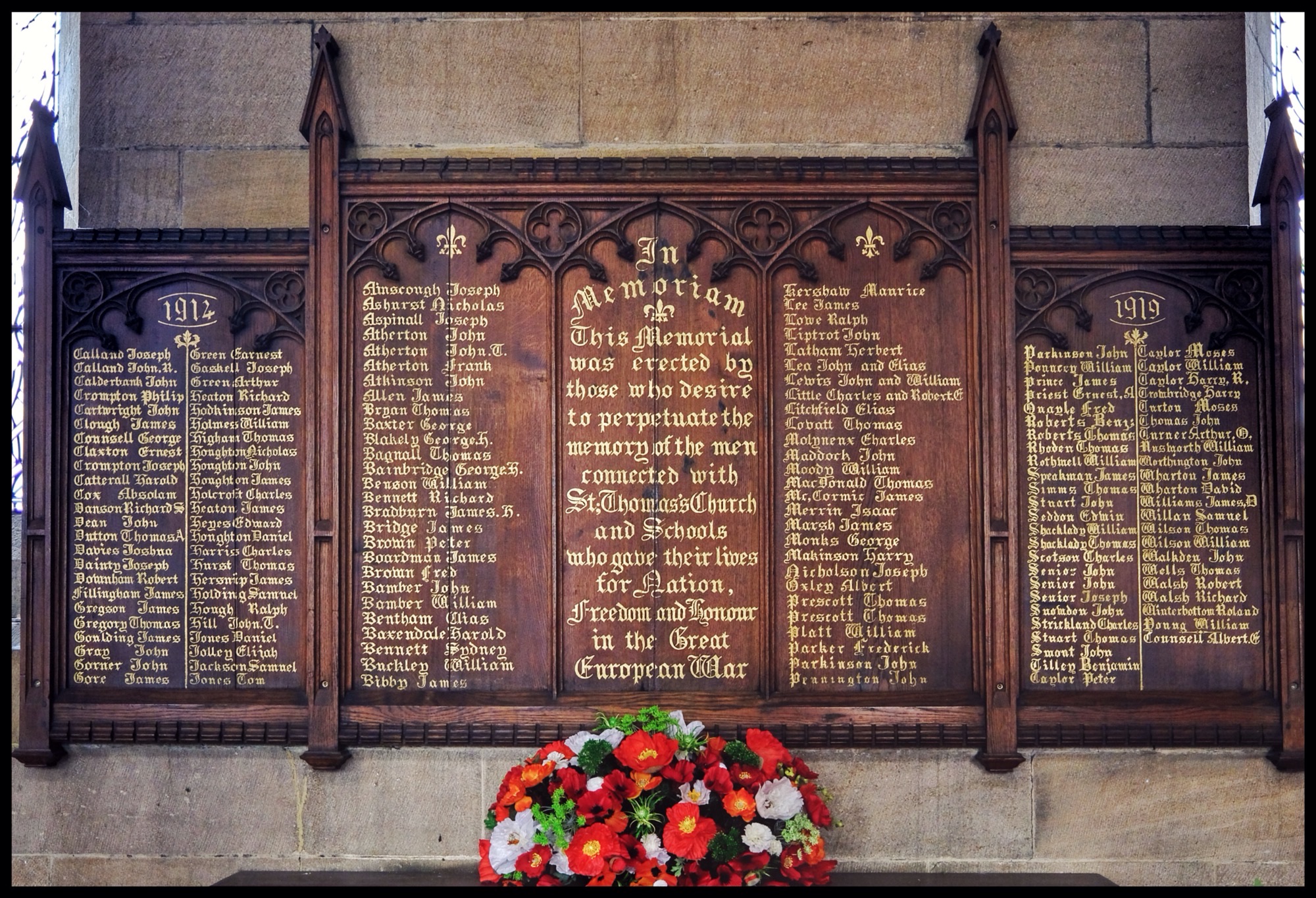
When the church closed the altar was preserved and is still used for its original purpose at St. Francis Church, Kitt Green. Three windows, the War Memorial and the list of vicars are preserved in St. James’s Poolstock the church which, on closure, the parish of St Thomas’s joined. On the list of vicars is written the name Revd. Richard Tebbs, serving at St. Thomas’s from 1890 to 1913. Before becoming a vicar, he served as a soldier in India forming part of the guard of honour when the future King Edward 7th, then Prince of Wales, visited that country in 1875.
Arriving at St. Thomas’s Revd. Tebbs soon wrote to the Wigan Observer about the stench coming from the River Douglas and complained about the type of music the brass bands were playing in Mesnes Park on a Sunday. He chastised the sidesmen for their irregular attendance at church saying they would make all sorts of excuses for not coming to church but that, ‘it was never too wet to attend a football match’.
Revd. Tebbs died, still vicar of St. Thomas’s, in 1913 just before the First World War. His funeral took place at St. Thomas’s before interment at Christ Church, Parbold. His churchyard memorial, in the form of a Celtic Cross, tells us that he was vicar at St. Thomas’s for 24 years. The chancel and lectern at St. Thomas’s were draped, The Wigan Observer tells us, and the blinds in all the houses in the neighbourhood were drawn. The service was fully choral with Mrs. Tebbs choosing the hymns.
The 1951 Centenary Booklet lists the people involved in the parish. It’s good to see that women had by then taken their rightful place in church life. Nearly half of the church council were women, Miss J. I. Heaton was church secretary and third on the list behind the vicar and the stipendiary reader was Sister Miss E. Bednall of the Church Army. What was Sister Bednall’s role in the parish? We’ll never know now but she probably worked hard behind the scenes helping in services and caring for the people who lived around Lower Wallgate in that community of terraced houses now just a distant memory.
St. James, Poolstock still uses the title St. James with St. Thomas so the church demolished some 50 years ago isn’t forgotten. If you remember St. Thomas’s church, please do contact us. Correct us if we’ve got things wrong and share your memories. They’re very precious.
© Who Built Wigan's Churches 2024 - .
All rights reserved.