

St. Andrew’s is a large brick built church with a wooden bell turret rather than tower or spire. The parish has its origins when in 1870 a curate from All Saints, the Parish Church Revd. Arthur Legge began to hold services in schools in Marsh Green and Beech Hill. He involved himself in local affairs celebrating the arrival of a post box in the area and complaining about the amount of beer drunk in the area’s pubs. It was when Revd. William Wickham replaced Legge in 1878 that the project for a new church really began. Wickham sent out thousands of appeals for money to pay for the new church and eventually after a delay caused by the 1881 Miners’ Strike the building was finished and consecrated by the first Bishop of Liverpool, Right Revd. Dr. Ryle.
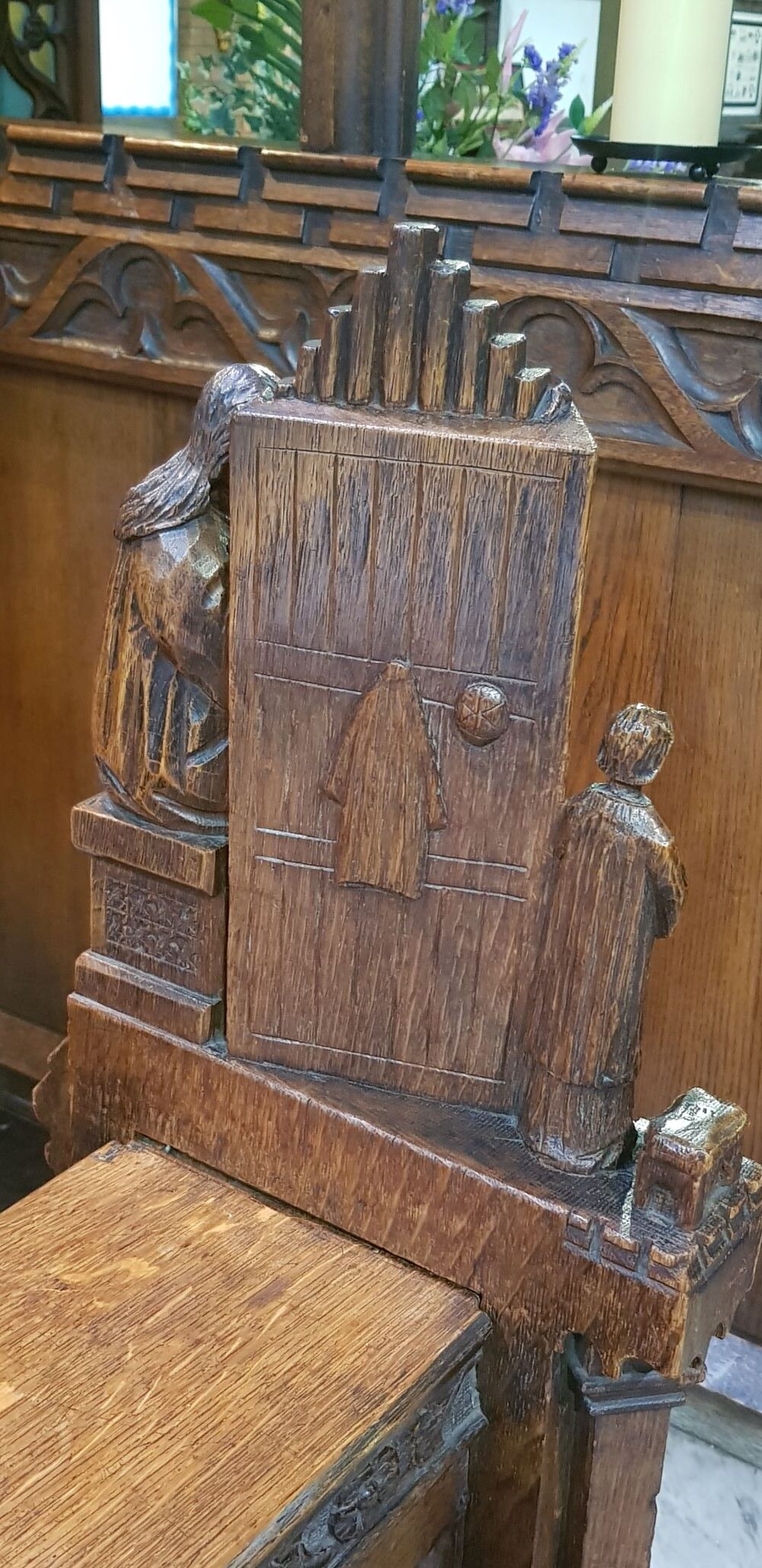
William Wickham is well known in Wigan for his photographs. He took some of the first photographs of miners working underground, of their families queuing up at soup kitchens during strikes and of the parishioners of St. Andrew’s themselves. He also set about making the inside of the church beautiful. He worked with a Derbyshire woodcarver, Advent Hunston, who carved the beautiful screen and choir stalls. Hunstone even carved the organist’s hat and coat hanging up on a peg! Wickham left St. Andrew’s in 1916. The following year his only son was killed in the First World War and in his memory but also in thanksgiving for the 38 years Wickham had spent at St. Andrew’s the magnificent stained glass window over the altar was put in.
The church is best seen from Mort Street with its three long windows, the tall buttresses between them and the circular window above making an impressive sight. Inside the decorative brickwork, sturdy stone pillars, Hunstone’s woodcarving and the mosaics makes St. Andrew’s one of the most interesting of Wigan’s churches. Rare appearance of a woman on the War Memorial, Jane Johnstone who had lived in the area.
There’s a lovely window in memory of Roy Taylor, organist at St. Andrew’s and music teacher at the Deanery High School. He wrote a history of St. Andrew’s Church in 1962 and it’s thanks to him we know so much about the church’s history.
Advent Hunstone’s carving
Two stained glass windows

© Who Built Wigan's Churches 2024 - .
All rights reserved.