
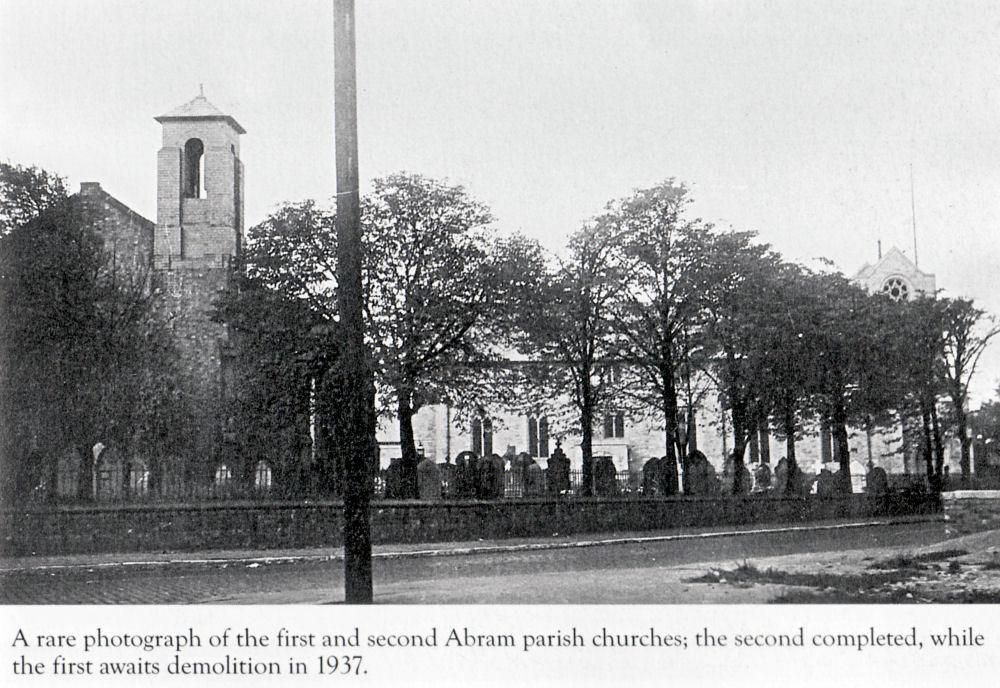
Set in a beautiful churchyard, St. John the Evangelist Church in Abram is another church in the Wigan area with a longer history than first appears. We were struck when we visited by how proud the people of Abram are of their church, still very much the centre of ‘the village’. The church we see now is, in fact, the second church to be built in the churchyard.
The first one, the site of which is marked by a commemorative stone in the churchyard, was built in 1838. It was demolished due, in part, to mining subsidence. Photographs exist of the old church, and stained glass windows and memorials from it were carefully moved into the current church. The church, which was a simple, small building, without side aisles and with a simple bell cote rather than a tower, served the people of Abram as their church for very nearly 100 years.
The Foundation Stone for the new church was laid in 1935 and for a short time there were two churches in the same churchyard ,the old building being demolished as soon as the new one was ready to be used.
The St. John’s we see today is a much larger church and has wide aisles on both sides. It has an unusual saddle back tower with a ridge and two sloping sides which makes the church a focal point as you walk up Warrington Road from Platt Bridge. Inside the stonework is left exposed, the dressed red sandstone of the pillars, arches and window surrounds being particularly attractive. The arches themselves are tall and graceful and above them the windows of the clerestory allow light into the church.
The pulpit, the chancel wall and the sedilia (the vicar’s seat in the wall to the right of the altar) are of the same red sandstone and are ‘built in’, part of the architect’s overall design. Looking closely at the pulpit you can see the inscription telling us that it was the gift of the Mothers’ Union reminding us that the parishioners themselves contributed substantially towards the cost of the building. Elsewhere in the church the contributions of the children of the Sunday School and the First Abram Wolf Cubs are marked by inscriptions on the wooden altar rails and several pews.
The old church, though demolished, lives on in the new with several items from it being retained. There are, for instance, stained glass windows on the west wall depicting the Four Evangelists. They are a memorial to Helen Dixon who died in 1856, wife of Revd. John James Dixon, the first vicar. Another window commemorates Abraham and Catherine Ackers who lived locally at Bickershaw Hall and played an important role in getting the first church built. Elizabeth Bevan (1752-1833) who bequeathed £500 to the original church is commemorated by a marble plaque. These memorials take us back to the time when, on early maps, the church is marked completely surrounded by fields and gardens with the Buck’s Head pub, as now, next to it.
Other stained glass in the present church is, of course, more modern and perhaps more striking. Bible stories depicted include The Visit of the Three Kings and the Calling of the Disciples. Look carefully and you will see a picture of a monk, the maker’s mark of the firm Powell and Sons who designed and made these lovely windows.
Another Powell window depicts the Angel Gabriel visiting the Virgin Mary. This was given by the parishioners and friends of Revd. Thomas Frederick Brownbill Twemlow, vicar of the first church from 1902 to 1911. He was the vicar in 1907 when we’re told rather alarmingly that the old church building literally began to collapse. At a meeting attended by parishioners and the Bishop of Liverpool, Rt. Revd. Francis Chavasse, Revd. Tremlow described the deplorable state of the building and made the point that it was too small for its present use.
Revd. Twemlow immediately started a fund and he set in motion the process of building the new church. His impact on Abram was great and people there remembered him after his death in 1946 paying for the Annunciation window in his memory. We’ll write more about Revd. Twemlow in due course.
The need for a new church had been identified in 1907 but the First World War intervened so remarkably the old church continued to be used and it was only in 1935 that sufficient funds had been raised and building could commence. Revd. Twemlow was invited back from his then parish in rural Settle in Yorkshire, to cut the first sod when the building of the new church began on 10th July 1935.
In the churchyard there is the memorial to the Maypole Colliery Disaster which occurred nearby on 18th August 1908 when 75 men and boys lost their lives. The old church, as we have heard, was small, so the Memorial Service, which some 15,000 people attended, was held on a field just 100 yards from the Colliery. The Bishop of Liverpool, himself, returned to Abram to conduct the service. It must have been one of the most difficult services he ever led.
Beautiful red sandstone pulpit and screen integrated into the architecture
Modern stained glass window above the altar to mark the Millennium


© Who Built Wigan's Churches 2024 - .
All rights reserved.