

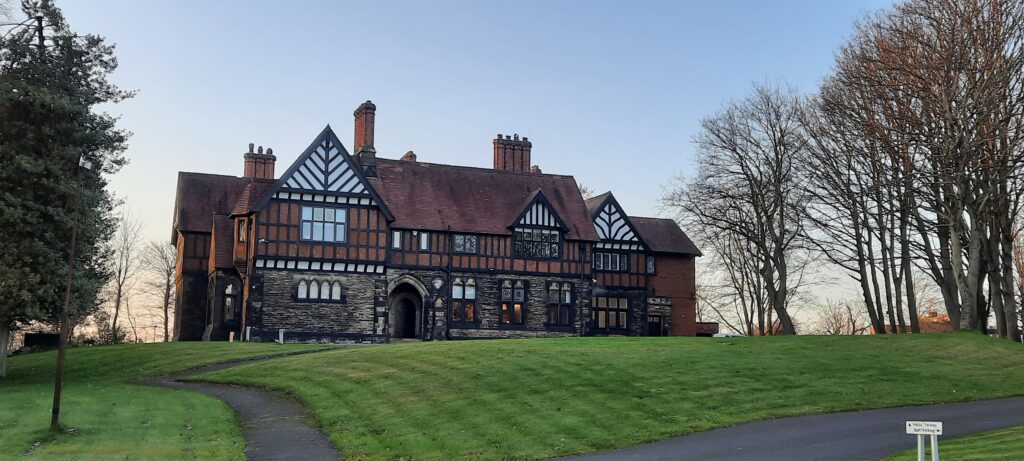
Architect also of ‘The Hall’, the former Rectory in New Market Street. Designer of St. Michael and All Angels school on Duke Street, Swinley and of the Bluecoat Infant school in New Market Street, both now demolished.
It is easy to find out about George Edmund Street, one of the most famous English architects of the nineteenth century. There are several books about him and plenty of information on the internet. The most famous building he designed is the Royal Courts of Justice on The Strand in London.
Street designed about 150 new churches mainly in the south of England and restored many more. He was responsible for churches in Rome, Paris and as far away as Istanbul. He designed several remarkable churches in North Yorkshire paid for by Sir Tatton Sykes, 5th Baronet, a wealthy, aristocratic landowner. He designed about 30 schools and 20 vicarages. Just before he died he was elected President of the Royal Institute of British Architects.
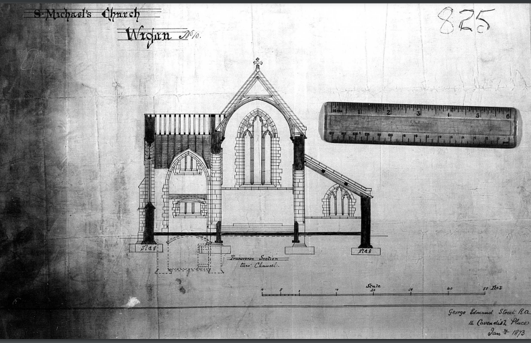
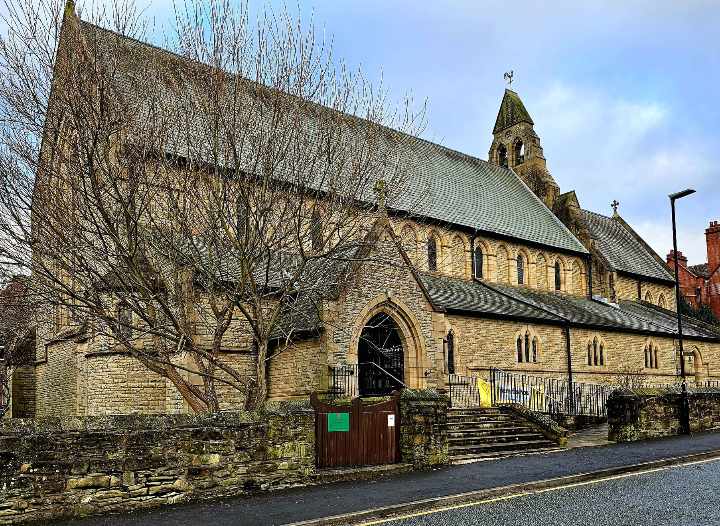
In Lancashire he was responsible for churches in Liverpool, Rochdale, Bolton and Swinton and, importantly for our purposes, in Wigan where he designed St. Michael and All Angels church in Swinley and ‘The Hall’, the former Rectory, the building which now serves as offices and dominates the view from the bus station. He was also responsible for two schools both now demolished. As we have noted before, Street is the only nationally famous architect to design a church in the town and we have long wondered how he came to work in Wigan.
We know that Street visited Wigan. He knew the Crawford family at Haigh Hall well and dined there in 1867 to discuss work he had agreed to carry out at the family’s Scottish home, Dunecht Castle. He was working for the future 25th Earl Alexander Lindsey who, as an art historian and collector, would have known Street’s work and was likely to have met him in London. Street went on to design a remarkable new library and chapel for Alexander at Dunecht.
But Street also knew the family of the Rector of Wigan of the time, Revd. George Bridgeman. George was from an aristocratic family, his father being the 2nd Earl of Bradford George Augustus Bridgeman. The family mansion was Weston Park in Staffordshire. When the Bridgemans restored St. Mary’s church at Blymhill on their own estate, the Weston Estate, in 1858-59 they gave the job to Street whose work they were presumably familiar with. The Rector of St. Mary’s church at the time was none other than the recently ordained Revd. George Bridgeman, future Rector of Wigan, himself. The work authorisation reads:
George Thomas Orlando Bridgeman Clerk Rector … is authorised and empowered to take down the gallery on the West side (Tower end) and the wall on the north side of the said Church, to widen and extend the same on the North side, to make an aisle on the same side, to stop up the present entrance (through the Tower) and to erect a Porch on the North side, and to erect new roofs over the whole Church.
Street worked on other churches on the Weston Estate restoring the church of St. Andrew in Weston under Lizard in 1869. He must have been very much at ease in aristocratic company. Many of his churches were designed for titled patrons.
When Rector Bridgeman arrived in Wigan in 1864, he was in a hurry to make an impact on the town, specifically to provide schools where children could receive a Christian education. Two new school buildings were planned, one in Duke Street, the other in New Market Street. He turned to Steet, by now perhaps a good friend, to design them both. The buildings are described in The Wigan Observer of 27th April 1867 which reported on the grand opening of the two schools. Starting with The Bluecoat Infants’ School, The Observer tell us:
‘The dimensions are 66 feet by 28 feet, the architecture is Gothic, and the structure, though plain, is remarkably handsome. Its appearance to our thinking, is rather more pleasing than that of the school in Swinley, which is to some extent Elizabethan in its character’.
The second school referred to is, of course, St. Michael and All Angels on Duke Street, which we (Pat and Will) both attended. For ten years this school in Swinley also served as a church for the area.
By the mid-1870s Bridgeman was keen to make his mark in the town in grander ways. The old rectory he had moved into in 1864 was in a poor condition being undermined by coal workings. He needed a new rectory, one which reflected his aristocratic status and position in the town and he turned again to Street. Grade Two listed, The Hall, built in 1875-6, is a remarkable building with a stone lower storey and a red brick and half-timbered upper storey. The impressive gatehouse on Frog Lane is now used by the Deanery High School. The Hall must be one of Street’s largest (and finest!) domestic buildings.
At the same time as The Hall was being built, plans being made for a new church in Swinley, the existing school building being felt to be unsuitable as a place of worship. The Swinley area was ‘on the up’ with the fine new terraces in Swinley Road being built and Rector Bridgeman gave a sum of money to get the new impressive church built. Street, whose design for The Hall had just been realised, was an obvious choice to be the architect and probably dashed off the plans for St. Michael and All Angel’s quickly. The church was consecrated in 1878 with no mention of Street attending the service.
Street, then, was well known to the ‘movers and shakers’ in the Wigan of the 1860s and 70s. Bridgeman knew him well, but the Crawford family too, already familiar with his work, must have added their support to the Rector in the belief that Street was the right man for the job.
Read more about the architects involved in building Wigan’s churches.
© Who Built Wigan's Churches 2024 - .
All rights reserved.