
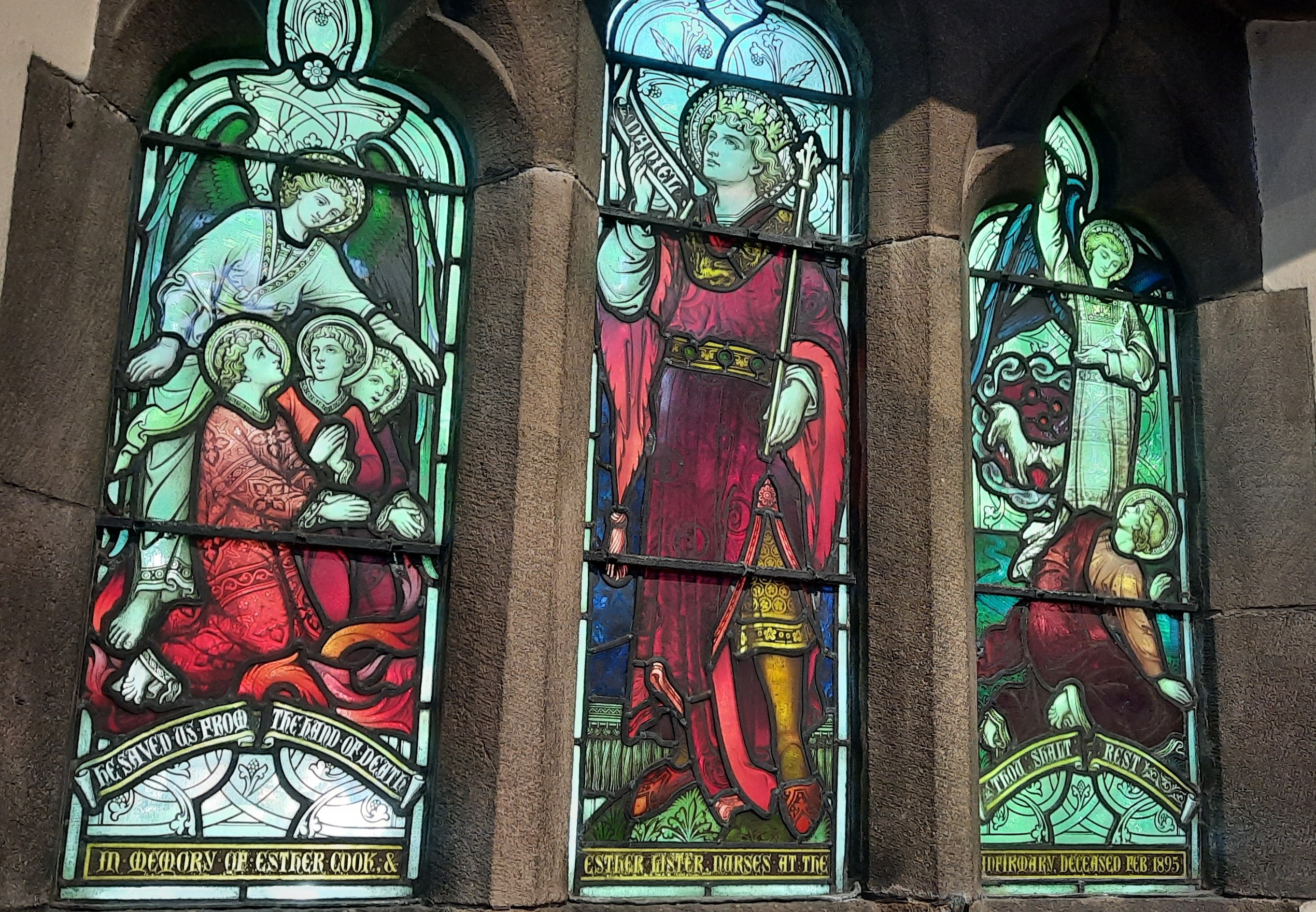
St. Michael’s church in Swinley has beautiful stained glass windows designed as a group to show Old Testament prophets such as Elijah and Joshua. They were all designed by Hardman and Co, a famous stained glass manufacturer in Birmingham, and were installed in the church in the 1890s.
Stained glass windows were often given to the church in memory of family members whose names are beautifully written in the glass at the base of the windows.
Using websites such as Ancestry and British Newspapers online, the real story about the people named can be discovered and in St. Michael’s one such example made us sit up and take notice.
On the left hand side of the church is a window dedicated to two women both co-incidentally with the name, Esther, fittingly the name of another Old Testament character. The dedication at the base of the window reads ‘In memory of Esther Cook and Esther Lister, nurses at the Infirmary deceased Feb 1895’ and it depicts the prophet Daniel.
We were immediately interested. Other windows in the church were given by the better known White and Matthew families but the surnames of the young women were new to us, not the familiar names of the great and good of the parish.
The Wigan Observer helped us out with this report on 10 May 1895.
‘With much regret the board records for the first time in the twenty-two years during which the hospital has been in existence, the death of two members of its nursing staff who contracted typhoid fever from a patient, and unfortunately, lost their lives in the discharge of their duty. The board have forwarded to the relatives of the nurses an expression of their sympathy.‘
By the following month the board recognised the need to mark the death of the two women. From The Observer again:
‘At the meeting at the board of management …..a question was raised as to whether the board proposed to take any steps towards placing a permanent record, either in the institution or elsewhere of the services rendered by two of the nurses who died recently while in the service of the hospital through having contracted typhoid fever and if so, what shape this memorial should take.‘
We can assume that the permanent record was the window, as in the July edition of St. Michael’s parish magazine we are told that the funds for the window were raised by the staff at the Infirmary.
It is notable that in both official Infirmary reports, the names of the nurses were not given.
Back to The Observer in October 1895, which gives us some details about the window:
“The window in memory of Esther Cook and Esther Lister, the two nurses who died in the Infirmary of typhoid at the beginning of the year, has been placed in the church.
It is, we think, one of the most successful of the aisle windows. The subject is Daniel, who stands in the centre light with coronet and sceptre, as one who was the ruler over the whole province of Babylon.”
The story of the two young women is not recorded on the window. We have tried hard to find out details about the them. There is very little to report because their lives were short. No real clues on the census and nothing more in the newspapers. What did being a nurse at the Infirmary in 1890s involve? What precautions were the nurses able to take? Did they put themselves at risk? Our recent experience during the pandemic reminds us again of the danger of infectious disease especially to health workers. Without the window the sacrifice of two Esthers would have remained unknown.
Records show that Esther Cook died on 28th February, 1895 at the Infirmary, aged 25 and was buried in Ince cemetery. Esther Lister was born in 1875 and died in March 1895 in Wigan.
UPDATE
We are grateful to a reader of the website who has provided us with more information about our two nurses and the window. We think that Esther Cook was born in Bedale in North Yorkshire in around April 1869. Her dad was schoolmaster at the National Schoolhouse there. Esther moved with the rest of her family to Birmingham and sometime in 1891 she started her nursing training, presumably in Wigan. When she died from typhoid, it was presumably considered unwise to transport her body back to Birmingham, given that she had died of an infectious disease and so she was buried in Ince.
Esther Lister was born in Prestwich in Manchester in 1874. Her dad was a dairyman and nurseryman employing one man. By 1876, the family had moved to North Meols in Southport. Esther died on 10 February 1895, just before her 21st birthday and was interred in Duke Street cemetery in Southport with her parents.
And finally a fact about the window from The Nursing Record and Hospital World, 12 October 1895
‘The Matron, Miss K. V. MacIntyre and the nurses of the Wigan Infirmary have subscribed and placed a beautiful window in St. Michael and All Angel’s church in memory of Esther Cook and Esther Lister, two dear young nurses who died in the Infirmary of virulent attacks of typhoid fever within a fortnight of each other which they contracted in the performance of duty whilst nursing a patient whose life they saved at the sacrifice of their own.‘
Find out more about St. Michael and All Angels church
© Who Built Wigan's Churches 2024 - .
All rights reserved.